

Introduction
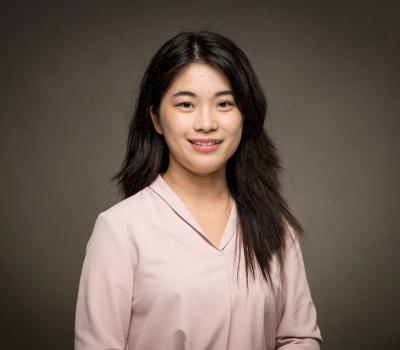
When Wenqian Dong talks about supercomputers, she rarely starts with machines. She starts with people — scientists trying to answer urgent questions about climate, energy, and complex physical systems, and running headlong into the limits of computation.
“Large‑scale scientific simulations drive discovery across so many domains,” Dong said. “But they’re incredibly expensive to run, and they don’t always scale well on modern hardware.”
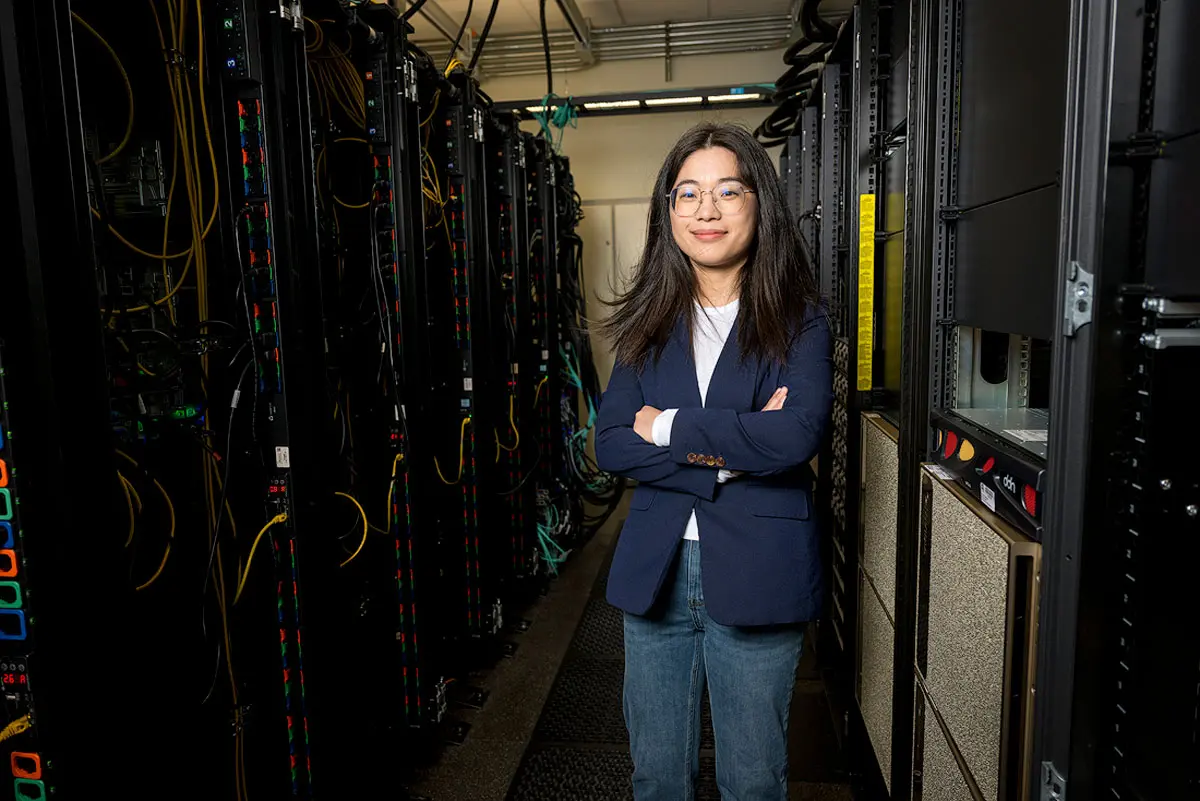
Dong, assistant professor of computer science, sits at the intersection of high‑performance computing and artificial intelligence. Her research focuses on a deceptively simple idea: instead of forcing traditional scientific codes to keep up with rapidly changing supercomputing hardware, let machine‑learning models take over the most computationally painful parts of the job.
assistant professor of computer science
Blue Primary, Yellow Secondary
The approach centers on what Dong calls machine‑learning surrogates — neural networks trained to approximate the behavior of complex physics‑based simulations. These surrogates don’t replace science with guesswork. Instead, they learn the relationship between inputs and outputs so well that they can stand in for the most time‑consuming steps of a simulation, often cutting runtimes from weeks or months to hours or days.
“Hardware is transforming very quickly, and the AI models are transforming very quickly,” Dong said. “That creates an opportunity to rethink how we do scientific computing.”
Bridging two worlds
Dong knows both sides of that divide. Trained in computer science and high‑performance systems, she now leads the Parallel Intelligent Computing (PiComp) Lab at Oregon State and co-leads the High-Performance Computing and Systems (HipCastor) Lab with four other faculty members. In both capacities, she collaborates closely with domain scientists working in energy systems, fluid dynamics, and climate modeling. Her work also reflects experience gained through collaborations with national laboratories and industry — including Argonne National Laboratory, Oakridge National Laboratory, and Pacific Northwest National Laboratory, where she interned with the lab’s HPC group, Cerebras, and Hewlett Packard Enterprise — where the gap between cutting‑edge hardware and legacy scientific software is especially clear.
Dong describes how many scientific applications — often written decades ago in languages like Fortran or C++ — rely on iterative numerical methods that are hard to parallelize efficiently. “These codes are mission‑critical,” she said, “but they were never designed for today’s heterogeneous systems.”
AI researchers, by contrast, benefit from mature frameworks like PyTorch and TensorFlow that make it relatively easy to exploit GPUs and other accelerators. “If you’re training a large language model, you already have the tools to scale,” Dong said. “For domain scientists, that’s usually not the case.”
Her research aims to close that gap without asking scientists to rewrite everything from scratch.
Power grids, fluids, and physics
One of Dong’s flagship examples involves large‑scale power‑grid simulation, where operators must repeatedly solve nonlinear equations to determine how electricity flows through tens of thousands of nodes. These simulations are expensive and must be repeated frequently to ensure safety and stability.
“What we do is use an ML surrogate to predict good starting points for the solver,” Dong explained. “Instead of taking 20 iterations to converge, you might only need three or five.”
Crucially, her models incorporate physics‑informed learning, embedding domain knowledge directly into the training process. “We add physical constraints into the objective function,” she said. “So, the model isn’t just fast — it’s physically meaningful.”
Dong takes a similar approach to fluid and climate simulations, where surrogate models can skip over large portions of the numerical computation while still respecting the underlying physics. In some cases, she noted, surrogate‑accelerated simulations have achieved order‑of‑magnitude speedups while maintaining or even improving solution quality.
Trust, not just speed
Speed alone isn’t enough, especially for scientists who depend on simulations to guide real‑world decisions. Dong repeatedly returns to the question of trust.
“For domain scientists, an ML model is still an approximation,” she said. “They want guarantees about correctness and safety.”
Her solution is not to eliminate traditional simulations, but to combine them with AI. Surrogates provide fast, high‑quality estimates that can be fed back into physics‑based solvers, reducing the number of iterations required to reach a verified solution. “You use the surrogate for the first step,” Dong said, “and then let the original solver do what it does best.”
assistant professor of computer science
Blue Primary, Yellow Secondary
A new role for AI in science
Dong’s broader vision is a systematic framework that makes AI surrogates accessible to non‑experts. Her group is developing tools that automatically identify where surrogates can help, generate candidate models, and validate results against domain‑specific constraints.
A recent example is Lumos, an automated scientific machine‑learning workflow that simultaneously selects the most informative input features and prunes unnecessary model parameters during training. Rather than relying on manual tuning or domain‑specific heuristics, the framework builds compact surrogate models that remain accurate while dramatically reducing computational cost — often cutting model size by more than two‑thirds and speeding inference several‑fold across applications ranging from fluid dynamics to cosmology.
“The goal is to democratize this technology,” she said. “Scientists shouldn’t need to be machine‑learning experts to benefit from it.”
With supercomputers, like the NVIDIA machine that Mark III Systems will install in the Huang Collaborative Innovation Complex in 2027, growing more powerful — and more complex — Dong argues that AI will become an essential partner in scientific discovery, not a replacement for physics but a catalyst for progress.
“We’re not throwing away scientific models,” she said. “We’re giving them a smarter starting point.”