
Introduction
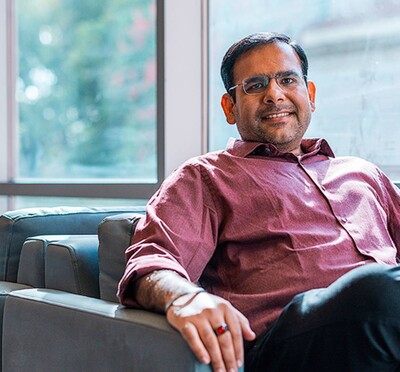
Jesse Rodriguez has been thinking about nuclear fusion since high school. The Oregon State University nuclear science and engineering alumnus — who went on to Stanford and Princeton before returning to Corvallis as a College of Engineering faculty member— has spent his early career building the computational tools to make fusion energy a reality. Next summer, he'll get a unique opportunity to advance that work: a hero run on OSU's new NVIDIA supercomputer in the Jen-Hsun Huang and Lori Mills Huang Collaborative Innovation Complex.
Rodriguez, the Nesbitt Faculty Scholar in Energy Engineering, is one of six inaugural recipients of Huang Complex Supercomputing Seed Fund, a program designed to prepare researchers to use the soon-to-be-completed Huang Complex at scale from day one. The seed grants, awarded through the university’s Research Computing Office, support the groundwork — code development, workflow optimization, and partnership-building — that enables researchers to conduct a full-scale experiment using the entire supercomputer in a single, coordinated push. For Rodriguez, that means training a massive deep learning model on 200 terabytes of plasma data from the largest operating magnetic confinement fusion facility in the United States.
"What we're doing here, you could not do it on anything other than an extreme leadership class computing facility," Rodriguez said. "The data and the models are just too big. It's not something that's feasible otherwise."
Taming turbulence in tokamaks
Fusion energy works by fusing hydrogen isotopes at extreme temperatures, replicating, in miniature, what the sun does continuously. The fuel is abundant, the reaction produces no carbon emissions, and unlike fission reactors, a fusion device that loses control simply shuts down rather than running away. "It's safe, it produces no emissions whatsoever, and the fuel for it is essentially just water," Rodriguez said. "We have enough fuel on planet Earth to power all of humanity's activities for billions of years."
Nesbitt Faculty Scholar in Energy Engineering
Blue Primary, Yellow Secondary
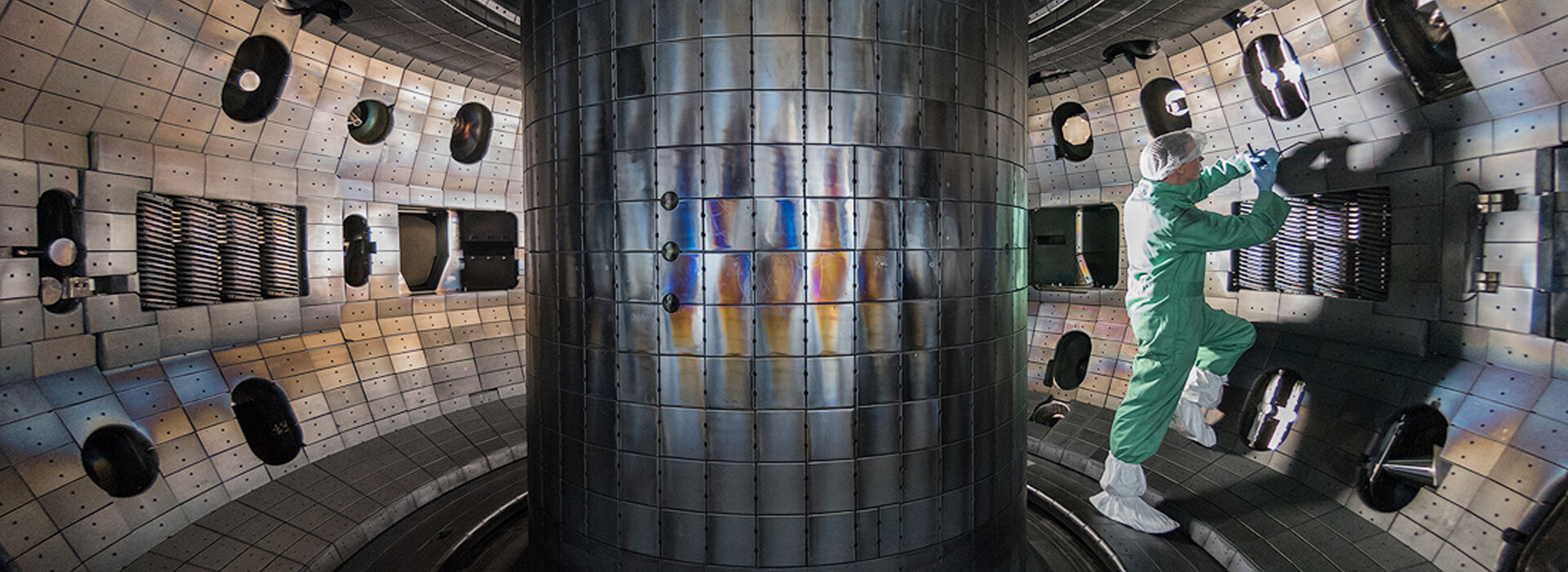
The catch is plasma. Achieving and sustaining a burning plasma inside a tokamak — the doughnut-shaped magnetic confinement device that is the dominant design for fusion reactors — requires navigating a gauntlet of instabilities. Chief among them are disruptions: sudden, turbulent events that can collapse the plasma and, in large-scale reactors, damage the machine itself. Predicting disruptions in real time has remained out of reach because the physics-based simulations required are far too computationally expensive to run faster than the events unfold.
Deep learning offers a different path. Rodriguez's lab has been building toward a 10-billion-plus-parameter AI foundation model trained on experimental data from DIII-D, the tokamak operated by General Atomics in San Diego. DIII-D has been producing experimental data since the 1980s, and its archive — roughly 200 terabytes — represents the richest record of plasma behavior available anywhere. A model trained on that full data set could serve as the basis for disruption prediction, real-time plasma control, and a digital twin of the reactor capable of simulating operating conditions that have never been experimentally tested.
Nesbitt Faculty Scholar in Energy Engineering
Blue Primary, Yellow Secondary
Why this machine, why now
The Huang Complex supercomputer's architecture makes it particularly well suited for this work. The system is built on NVIDIA's Vera Rubin platform — a next-generation GPU architecture optimized for the kinds of extreme-scale deep learning workloads that Rodriguez's project requires. He has trained large models on Frontier, the Department of Energy's flagship supercomputer at Oak Ridge National Laboratory, and found the experience instructive about the limits of general-purpose high-performance computing hardware for deep learning workloads.
"Having this NVIDIA hardware, where all of the machine learning frameworks are optimized to run on it, makes things a lot easier," he said. "And as far as I'm aware, there won't be another Vera Rubin cluster operational anywhere in the university and national lab ecosystem at that point. So, for that period of time when the facility opens, we're going to have the fastest car in the world of academic research — which will be pretty fun."
The hands-on team will be small: primarily Rodriguez and his Ph.D. student Noah Harris. But the work is embedded in a larger fusion research network that includes collaborators at General Atomics, UC Irvine, Princeton Plasma Physics Laboratory, and elsewhere throughout the Department of Energy and university ecosystem.
Rodriguez's team is already technically prepared for the run. His lab has demonstrated its software stack on H100 systems in Switzerland, meaning the code works on NVIDIA hardware and the remaining work is to optimize for scale. He is working with NVIDIA engineers — including Tom Gibbs and Steve Niemi — to ensure the training workflow is ready for the full Huang Complex system. The project is estimated to require on the order of 100,000 GPU hours or more.
Building something bigger
The hero run is a milestone, but Rodriguez is clear that it is a means, not an end. The foundation model produced by the run is intended to open a new chapter in how fusion experiments are designed and conducted, enabling what he describes as "self-driving" experimental workflows in which AI systems propose and execute plasma experiments in operating regimes that have been too risky to explore manually. If successful, the model will be open, with published weights that other researchers can use across the fusion energy sciences community.
"The hope is that this model will help unlock the ability to venture into extreme operating regimes, collect data in those areas, and show the path to actually operating these fusion pilot plants,” Rodriguez said. “This is the subject I’ve been most passionate about since I was in high school, and I’m excited to be working on it in any capacity, let alone in a capacity that could have a major impact on the field.”