
Introduction
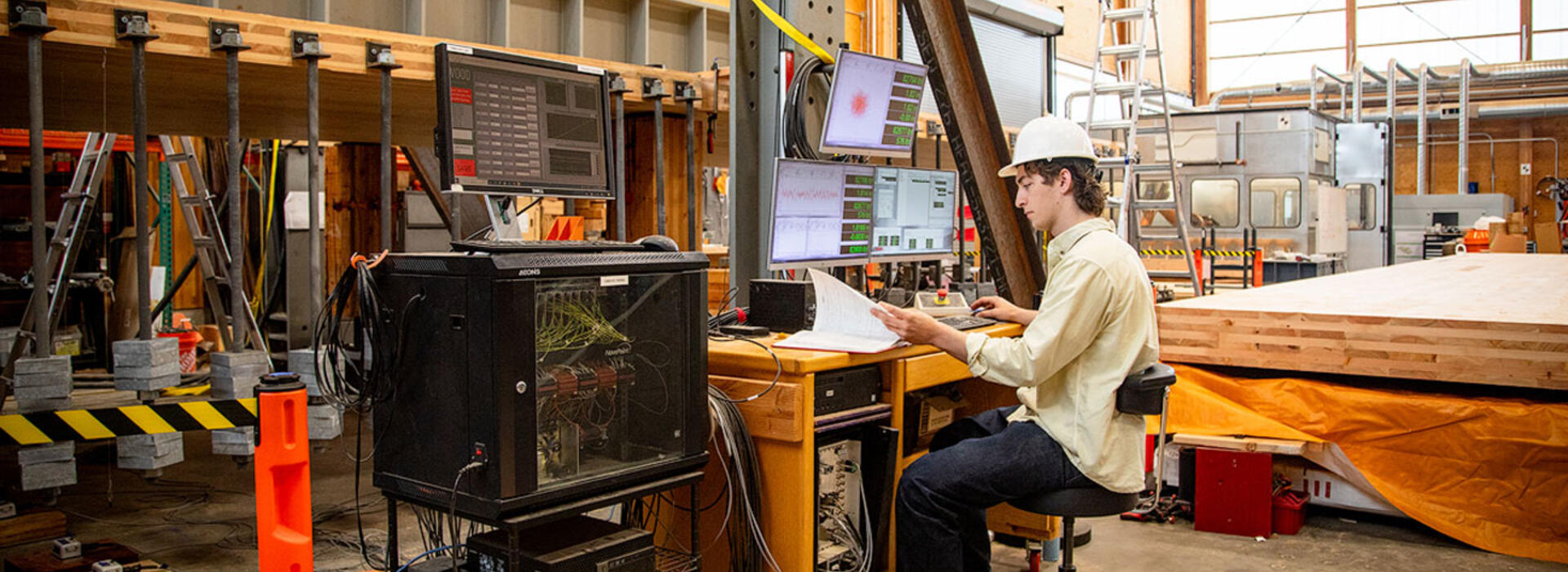
In a cavernous lab on the edge of campus, Dylan Goff monitors and adjusts dozens of sensors as massive timber panels endure up to 200,000 pounds of pressure. As a master’s student in civil engineering with a concentration in structural engineering, he is advancing research on a type of mass timber known as cross-laminated timber — large, engineered wood panels — and new approaches that eliminate traditional beams and girders.
The data that Goff captures will contribute to guidance that industry professionals are eagerly waiting to use in real-world applications and could ultimately lead to more efficient construction practices.
“My hope is that industry will start thinking about how to adapt their designs based on the data we've collected,” Goff said.
Structural engineering master’s student
Blue Primary, Yellow Secondary
Filling a critical research gap
Goff’s work focuses on point-supported timber panels, a method in which floor panels are supported directly by columns rather than by beams and girders. The system enables faster construction, more efficient use of materials, and greater design flexibility. But its adoption in the U.S. has been limited by a lack of research and design guidance.
“There’s not a lot of research on it,” Goff said. “So, it creates opportunities to contribute in meaningful ways.”
To help fill that gap, Goff’s work combines analytical modeling with full-scale physical testing. He develops computer models to predict how timber panels will respond under various loads, then tests those predictions by applying forces to full-scale panels.
Goff’s experiments also examine how openings for building systems — such as plumbing and HVAC — affect strength, and how additional forces, such as façade loads, influence behavior.
Each test helps refine the models that industry professionals will use in practice.
“We’re trying to make it really easy to use,” Goff said. “Engineers can build a quick model, get an understanding of loads, and move directly into the design phase.”
From classroom to lab
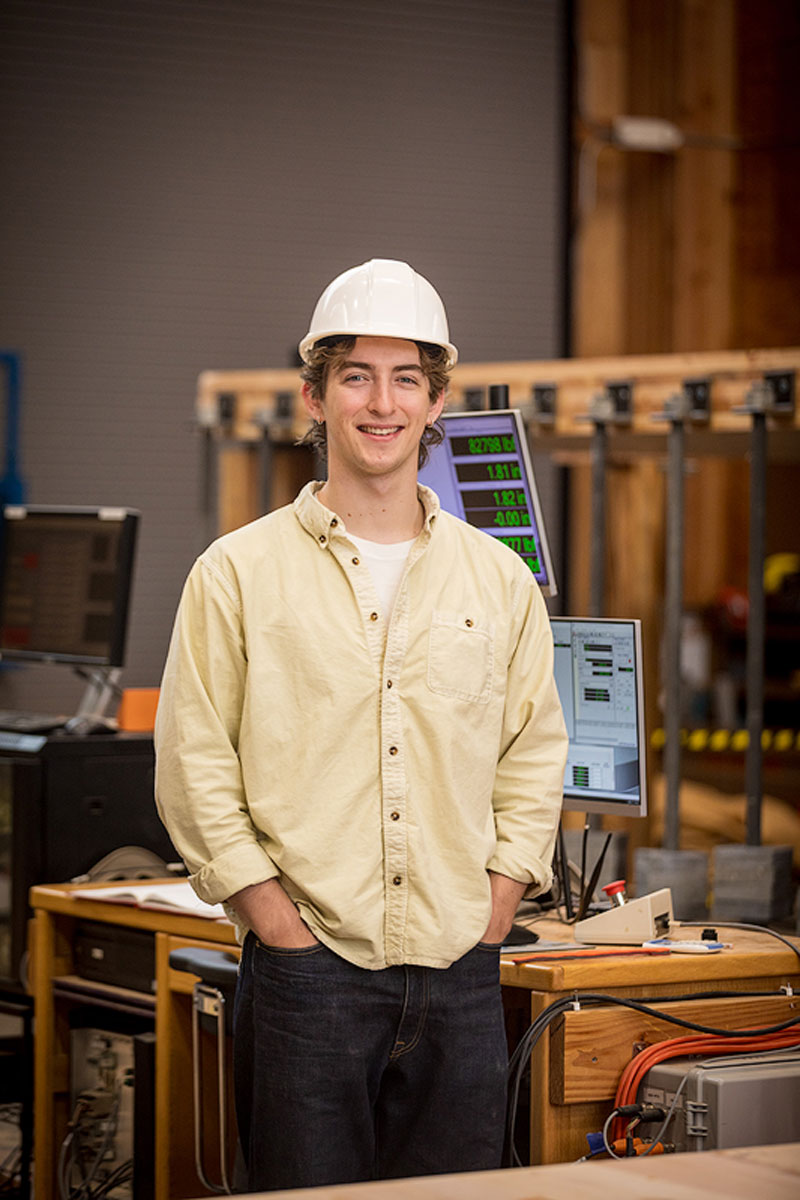
Growing up in the Pacific Northwest, Goff spent much of his time outdoors and had an early love of math and bridges. These interests later influenced his studies at Oregon State University, when he was introduced to mass timber in a wood design course taught by Andre Barbosa, Cecil and Sally Drinkward Professor in Structural Engineering.
Conversations with Barbosa led to a graduate research project focused on a new kind of structural system and the opportunity for Goff to take ownership of that work.
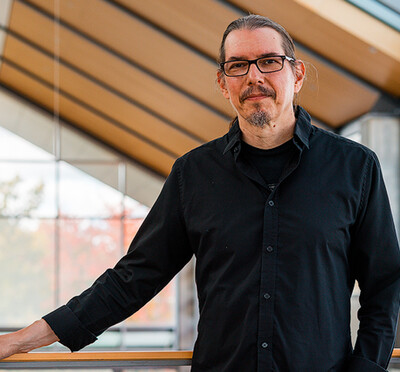
“Dr. Barbosa is a powerhouse in this field, and it’s been a privilege to work with him,” Goff said. “He’s provided a lot of exposure for me with industry and at conferences. It’s been informative to see what good mentorship looks like.”
Goff’s research is led by Barbosa and funded by the USFS/USDA Wood Innovation Grant Program and the Tallwood Design Institute (TDI), a cross-university collaboration that works closely with industry partners to identify pressing research questions. Additional support comes from Research on Engineering, Architecture and Construction of Timber Structures, an industry-led research consortium based at TDI with members across the AEC and manufacturing sectors.
“Through an industry-led research consortium at TDI, I have had meetings where they tell me they have been waiting for this research,” Goff said. “They are ready to start building — and it’s exciting as a student to contribute to their world as I’m preparing to enter it.”
Building with purpose
For Goff, the significance of the work extends beyond structural performance. Mass timber represents a renewable building material with the potential to reduce the environmental impact of construction.
“Using eco-friendly resources is going to make an impact,” Goff said. “It’s been gratifying to work on something that’s going to help the Earth.”
That sense of purpose carries into the lab, where Goff leads a team of undergraduate students who help set up testing and collect data.
“It’s definitely a team effort, and it’s been really cool to see undergrads getting excited and into mass timber the same way I did,” Goff said. “I want to help inspire them to keep going in this industry.”