

Engineering+
Experience hands-on projects, discover diverse pathways, and gain essential skills with our innovative Engineering+ program
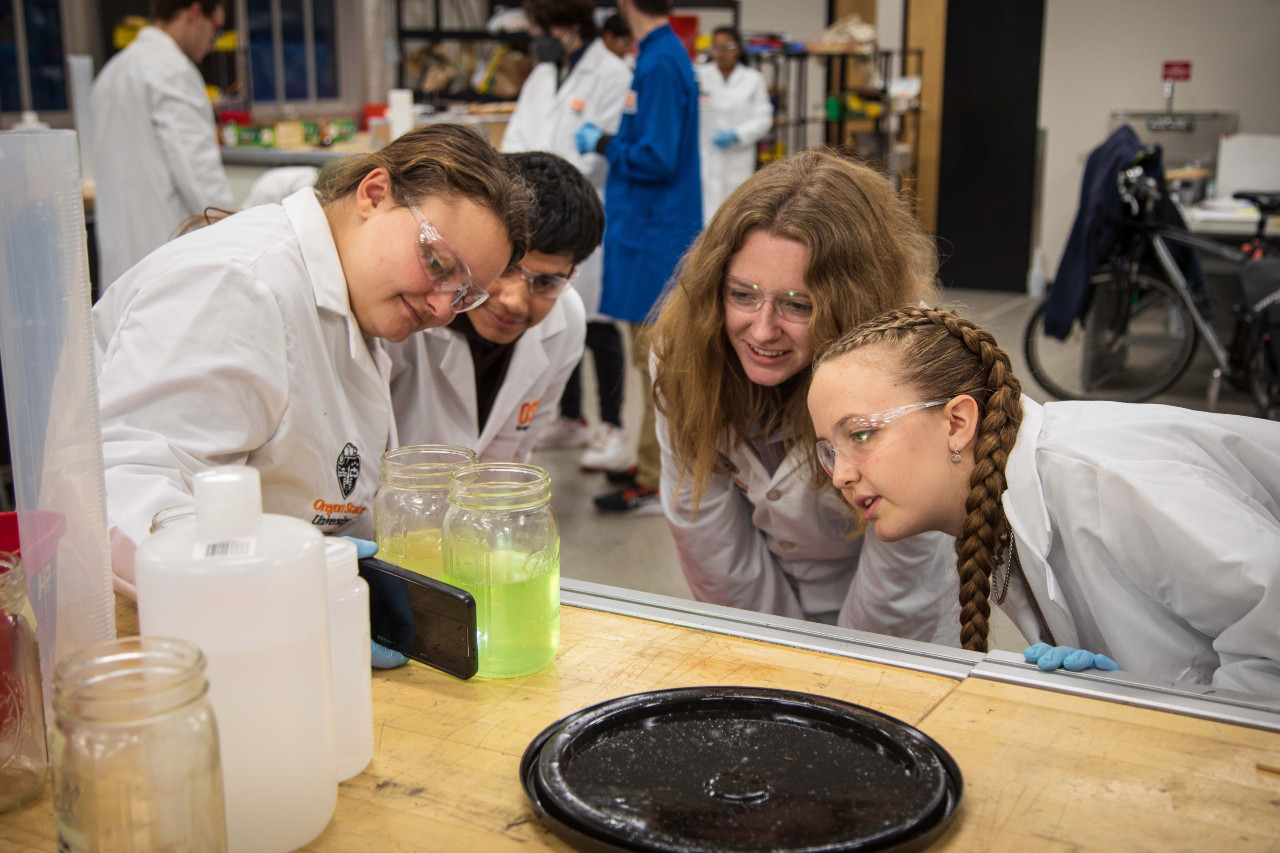
Engineering+ propels you into a dynamic learning environment where you'll collaborate with peers, tackle real-world challenges, and explore various engineering disciplines through engaging projects. Our faculty mentors will guide you on your journey, fostering an inclusive mindset and preparing you for success in your chosen field.
Go beyond the textbook and embrace active learning experiences
- Project-based learning: Apply theoretical knowledge to solve real-world engineering problems through collaborative projects.
- Major exploration: Dive into diverse engineering disciplines and discover your perfect academic fit.
- Professional development: Build valuable connections at Oregon State and beyond with industry professionals to gain insights and launch your career.
- Inclusive learning: Develop a well-rounded understanding of how engineering impacts the world and promotes diverse perspectives.
Whether you have a specific career goal in mind or are still exploring your options, Engineering+ equips you with the foundation and confidence to thrive at Oregon State and beyond.
Upcoming Engineering+ Events
Courses
Over your first three terms, you’ll take three 3-credit courses that explore various intersections of engineering, society, and the environment. Each on-campus course meets twice per week for one-hour lectures and once per week in a smaller group for a two-hour studio.
- Studios are an OSU-specific course structure that supports students in practicing engineering work in authentic situations - collaborating in small groups on complex open-ended problems with multiple constraints and stakeholders.
Fall 2026
Each section of ENGR 115 is paired with a section of ENGR 110 to be consistent with the instructor of record. ENGR 110 is the Core Education lower-division Transitions course.
The Skyscraper: Sustainable and Resilient Construction
Buildings are everywhere but do you know how they are planned, designed, and constructed? In this course we will explore how designers, engineers, and constructors work together to create sustainable and resilient structures. You and your team will have fun during studio activities that introduce different aspects of the design and construction process.
Campus: Corvallis
Instructor: Ingrid Arocho
110 CRN: 17187
115 CRN: 17243
Engineering for People, Climate, and Ecosystems
This section focuses on the interface between humankind and landscape scale management processes that contribute to anthropogenic climate change. Specific topics focus on carbon dioxide dynamics in managed and unmanaged ecosystems including sequestration and release of carbon dioxide from soils and woody biomass. Explore the ethics of generating data for AI tools and the resource impacts. Complete a team project in these topic areas and relate it to your goals as an engineering student.
Campus: Corvallis
Instructor: Frank Chaplen
110 CRN: 17191
115 CRN: 17244
Engineering for Sustainable Development and Disaster/Emergency Response
Through the lens of the United Nation's Global Sustainable Development Goals, this course explores how the different types of engineering disciplines can help meet global needs for energy, clean water, electricity, transportation, health, and housing. Together we'll design solutions for each of these through hands-on experiments and consideration of the technical, social, environmental, and economic context for a specific place in the world that is undergoing development and/or disaster and emergency response.
Campus: Corvallis
Instructor: Nordica MacCarty
110 CRN: 17195
115 CRN: 17245
Engineering Clean Water for Environment, Health and Survival
In a rapidly changing world, access to clean water will be humanity’s most important challenge and threat. In this class, we will explore how every engineering field plays a critical role in helping to provide and preserve clean water for the planet. Through case studies, we will learn the broader impacts of engineering decisions on society. Additionally, through hands on learning we will design, create and test emergency sand water filters that will help your community survive a Cascadia-event earthquake. Finally, we will discuss what it takes to be a successful engineer and how you can utilize OSU resources and opportunities to set yourself up for success, at OSU and in the work force.
Campus: Corvallis
Instructor: Tyler Radniecki
110 CRN: 17199
115 CRN: 17246
Mission to Mars - Engineering Challenges - Biochemical and Biomedical Solutions
Embark on a mission to Mars and face various engineering and health challenges along the way. Discover how engineering and science play a critical role in your mission and how to ensure astronauts’ safe return home. You will design technology and conduct experiments to address a challenge such as:
- Produce oxygen by recycling CO2 from the spacecraft cabin through algae growth in a photo-bioreactor
- Design a biomedical device to remove plasma-free iron from an astronaut's bloodstream.
Campus: Corvallis
Instructor: Goran Jovanovic
110 CRN: 17203
115 CRN: 17247
Take It Apart! Reverse Engineering for Change
Ever take something apart to see how it works only to realize you could design it better? Explore engineering concepts while learning how products function and how we can design for change.
Campus: Corvallis
Instructor: Sarah Oman
110 CRN: 17208
115 CRN: 17248
Innovation and Entrepreneurship: Engineering for the Future
Explore how engineers, innovators, and entrepreneurs are shaping the future through artificial intelligence, rapid prototyping, automation, and startup creation. Learn how to identify real-world problems, develop technology-driven solutions, build AI-assisted software products, collaborate in teams, and communicate ideas through business pitches and technical demonstrations. Topics will include AI and vibe coding, entrepreneurship and startup culture, sensors and automation and ethical and societal impacts of technology.
Campus: Corvallis
Instructor: Jason Clark
110 CRN: 17213
115 CRN: 17249
Energy Production and Justice on Earth - Implications for Space Colonization
Explore the connection between energy production and social justice on Earth and how it impacts our future in space colonization. You’ll get a deep understanding of the ethical, environmental, and societal dynamics in today's energy landscape. You will also explore how equitable access to resources, sustainable energy solutions, and responsible community-building will be essential for human expansion beyond Earth. Join us and be part of the transformation as we work to create a blueprint for a brighter, more equitable, and responsible spacefaring future.
Campus: Corvallis
Instructor: Alexander Chemey
110 CRN: 17217
115 CRN: 17250
Sustainable and Resilient Construction: The Bridge
Ever thought about how bridges are designed and constructed? This course explores how major bridges are designed and constructed and how engineers and scientists are pursuing methods to make the design, construction, and operation of these major engineering accomplishments more sustainable (e.g., meeting today’s needs without sacrificing future needs) and resilient (e.g., able to resist earthquakes, tsunamis, malevolent attacks). The class introduces critical aspects of the design and construction of bridges with engaging and fun studio activities that emphasize these critical aspects.
Campus: Corvallis
Instructor: David Trejo
110 CRN: 17227
115 CRN: 17252
Innovation and Entrepreneurship: Engineering for the Future
Explore how engineers, innovators, and entrepreneurs are shaping the future through artificial intelligence, rapid prototyping, automation, and startup creation. Learn how to identify real-world problems, develop technology-driven solutions, build AI-assisted software products, collaborate in teams, and communicate ideas through business pitches and technical demonstrations. Topics will include AI and vibe coding, entrepreneurship and startup culture, sensors and automation and ethical and societal impacts of technology.
Campus: Corvallis
Instructor: Jason Clark
110 CRN: 20046
115 CRN: 20047
Engineering Systems for a Better World (Honors College)
Learn how to see the systems all around you — the people, technology, energy, and information — that play a key role in building and maintaining a better world. Explore how all engineering disciplines play a part in human-machine systems and build your engineering, creativity and innovation skills.
Campus: Corvallis
Instructor: Cynthia Horta Martinez
110H CRN: 17887
115H CRN: 17888
Engineering a Circular Materials Economy (Honors College)
Our society is facing a convergence of social-justice and environmental issues, from production of green-house gases resulting in climate change to the accumulation of waste plastics in our oceans; there has never been a greater need for technological innovation to manage our waste. Discover how engineers of various disciplines are developing new technologies to birth a circular-materials economy that will enhance our society’s environmental sustainability and social equity. Along the way, you will develop the foundational habits of an Oregon State Engineer: collaborative problem-solving, quantitative reasoning, and social & ethical practice.
Campus: Corvallis
Instructor: Lucas Ellis
110H CRN: 17885
115H CRN: 17886
Engineering Considerations for a Digital World
Develop the skills needed to succeed both at Oregon State and in your future engineering career. Practice effective teamwork that considers social justice, inclusion, and equity. Analyze professional codes of conduct and ethical practices through the lens of multidisciplinary and societally relevant challenges. Strengthen critical thinking and collaboration skills to identify engineering problems and articulate possible solutions.
Campus: Ecampus
Instructor: Maher Elshakankiri
110 CRN: 17917
115 CRN: 17871
Design Across Disciplines
Begin establishing the foundations necessary to be a successful engineer in any field.
Campus: Cascades
Instructor: Kenneth Martin/Rebecca Webb
110 CRN: 17133
115 CRN: 17134
Building Your Foundation: Success in College and Beyond
Success in engineering requires more than technical knowledge. In this course, you will develop the academic, professional, and personal skills that support long-term success in college and your future career. Through hands-on projects, teamwork, and reflection, you will explore topics such as effective learning strategies, time management, communication, professional development, and physical and mental well-being. You will also discover the many resources available on campus to support your academic achievement, personal growth, and overall success as a student. Throughout the term, you will build and maintain a personal website to showcase your work, document your growth, and create a portfolio that reflects your journey as an engineering student.
Campus: Cascades
Instructor: Dan White
110 CRN: 17643
115 CRN: 17644
Designing Structures and Machinery
Learn how engineers translate highly complex real‑world phenomena into solvable models by applying conservative assumptions, reducing intricate interactions among materials, geometry, and loads into forms that can be analyzed, designed, and verified with confidence.
Campus: Corvallis
Instructor: Mark McQuire
CRN: 14147
Applied Engineering Thinking
Investigate engineered systems of your choice while applying the research-based engineering thinking techniques you’ll learn in the course. Student projects have included: astrophysics of meteorites, forest fire modeling and management, turbo-charged gasoline engines, wind turbine optimization and water treatment through restored wetlands.
Campus: Corvallis
Instructor: Devlin Montfort
CRN: 14988
Inclusive Engineering and Strategic Planning
Explore techniques including problem identification and definition, idea generation, team building, experimental design, and resource allocation. Discover theory behind inclusive professionalism, professional inclusivity, approaches to design, monitor, and control complex systems. Use engineering tools, and implement techniques crucial to push technology forward ethically in a globalized and globalizing world.
Campus: Corvallis
Instructor: Ingrid Scheel
CRN: 20032
Computational Foundations in Engineering
Explore foundational engineering concepts such as design principles, usability, problem solving, computational thinking, and logic. Gain knowledge of Boolean algebra, truth tables, circuit diagrams, and Python. Start building skills to find a job, and boost teamwork, communication, and technical writing skills through group projects focusing on design and use of software in diverse ways.
Campus: Ecampus
Instructor: Samarendra Hedaoo
CRN: 17869
Computational Engineering in Daily Life
Gain confidence using core programming concepts, such as variables, expressions, conditions, control structures, functions, and simple 1-d and 2-d structures, to solve real-life problems using computations.
Programming language: Python
Campus: Corvallis
Instructor: Tingwei Zhang
CRN: 14669
Computational Thinking by Tinkering with Python
Learn programming in Python by taking apart code examples to dissect, reverse engineer, modify, and adapt them. Then, solidify your understanding of the patterns you’ve discovered by designing new programs from scratch.
Programming language: Python
Campus: Ecampus
Instructor: Doshna Umma Reddy
CRN: 17870
Spring 2026
Each section of ENGR 115 is paired with a section of ENGR 110 to be consistent with the instructor of record. ENGR 110 is the Core Education lower-division Transitions course.
Engineering Systems for a Better World
Learn how to see the systems all around you — the people, technology, energy, and information — that play a key role in building and maintaining a better world. Explore how all engineering disciplines play a part in human-machine systems and build your engineering, creativity and innovation skills.
Campus: Corvallis
Instructor: Cynthia Horta Martinez
CRN: 61502 (ENGR 110), 61503 (ENGR 115)
TBD
TBD
Campus: Corvallis
Instructor: Kevin Houser
CRN: 61504 (ENGR 110), 61505 (ENGR 115)
Engineering Considerations for a Digital World
Be successful both at Oregon State and in your engineering career. Uses effective teaming practices that account for social justice and equity. Analyze professional codes of conduct and ethical practices in engineering professions through the lens of multidisciplinary and societally relevant engineering challenges. Develop critical thinking skills to collaboratively identify engineering problems and to articulate possible solutions.
Campus: Ecampus
Instructor: Maher Elshakankiri
CRN: 61538 (ENGR 110), 61539 (ENGR 115)
System of Systems Engineering
In this course, you'll learn how to design, model, and simulate complex systems comprised of independent subsystems that must work together to achieve important real-world tasks. You will work in teams, learn graphical programming, test hypotheses, and contribute to technical reports.
Campus: Corvallis
Instructor: Jason Clark
CRN: 55991
Computational Foundations in Engineering
Explore foundational engineering concepts such as design principles, usability, problem solving, computational thinking, and logic. Gain knowledge of Boolean algebra, truth tables, circuit diagrams, and Python. Start building skills to find a job, and boost teamwork, communication, and technical writing skills through group projects focusing on design and use of software in diverse ways.
Campus: Ecampus
Instructor: Samarendra Hedaoo
CRN: 55988
Computational Engineering for One Planet
Familiarize yourself with core programming concepts, such as variables, expressions, conditions, control structures, functions, and simple 1-d and 2-d structures. Then put your new knowledge to the test, solving sustainability problems using computation. Programming language: Python.
Campus: Corvallis
Instructor: Rebecca Hutchinson
CRN: 55694
Computational Engineering for renewable energy
Explore the world of renewable energy through data analysis and Python programming. Gain programming and data analysis skills through project-based learning and design of new programs with applications in renewable energy. Programming language: Python
Campus: Corvallis
Instructor: Jasmine Kennard
CRN: 55699
Computational Engineering Big and Small
Explore core programming concepts, such as variables, expressions, conditions, control structures, functions, and simple 1-d and 2-d structures. Apply these concepts to engineering problems at a variety of length scales ranging from the nucleus to the solar system. Programming language: Python.
Campus: Corvallis
Instructor: Iza Gutowska
CRN: 55700
Shaping the World with Geospatial and Computational Engineering
Develop core computational thinking and python programming skills while applying geospatial principles to analyze spatial data, maps, and models related to the natural and built environment. Through interdisciplinary examples drawn from engineering, infrastructure, environmental systems, and societal challenges, you will learn how coding and geospatial sensors and data are used to design, analyze, and make informed engineering decisions. Programming language: Python.
Campus: Corvallis
Instructor: Mike Olsen
CRN: 55702
Visual thinking, visual coding
Explore foundations of programming: loops, functions, logical expressions, and data arrays by creating visual representations in code. Programming language: Python.
Campus: Corvallis
Instructor: Chad Higgins
CRN: 55704
Biosphere Code: Intro to Python for Living Systems
A beginner-friendly introduction to programming with a focus on biological and environmental applications. You will learn the building blocks of code, variables, loops, and logic, by solving simple puzzles inspired by nature. Programming language: Python.
Campus: Corvallis
Instructor: Cheng Li
CRN: 55706
Computational Engineering for One Planet
Familiarize yourself with core programming concepts, such as variables, expressions, conditions, control structures, functions, and simple 1-d and 2-d structures. Then put your new knowledge to the test, solving sustainability problems using computation. Programming language: C++.
Campus: Corvallis
Instructor: Jennifer Parham-Mocello
CRN: 55944
Computational Engineering in Daily Life
Gain confidence using core programming concepts, such as variables, expressions, conditions, control structures, functions, and simple 1-d and 2-d structures, to solve real-life problems using computations. Programming language: C++.
Campus: Corvallis
Instructor: Matthew Kenison
CRN: 55960
Computational Engineering for Real-World Systems
This course introduces core programming concepts including variables, expressions, conditional logic, control structures, functions, and basic one- and two-dimensional data structures. These tools are used to formulate and solve computational problems arising in engineering systems involving people, technology, energy, and information. Emphasis is placed on systems thinking, problem formulation, and using computation to support decision-making and optimization in real-world engineering challenges. Programming language: Python.
Campus: Corvallis
Instructor: Leandro Farias Maia
CRN: 55969
Computational Engineering in Daily Life
Gain confidence using core programming concepts, such as variables, expressions, conditions, control structures, functions, and simple 1-d and 2-d structures, to solve real-life problems using computations. Programming language: C++.
Campus: Corvallis
Instructor: Matthew Kenison
CRN: 61205
Analyzing Systems for a Better World
Explore core programming concepts, such as variables, expressions, conditions, control structures, functions, and simple 1-d and 2-d structures. Then solve problems for systems that involve people, technology, energy, and information. Programming language: Python.
Campus: Corvallis
Instructor: Phillip Carleton
CRN: 57076
Computational Engineering in Daily Life
Gain confidence using core programming concepts, such as variables, expressions, conditions, control structures, functions, and simple 1-d and 2-d structures, to solve real-life problems using computations. Programming language: C++.
Campus: Corvallis
Instructor: Matthew Kenison
CRN: 56272
The Python Prescription (Honors College)
Explore the development and production of pharmaceuticals through data analysis and mathematical modeling. Build your computer programming and problem-solving skills through project-based learning in Python.
Campus: Corvallis
Instructor: Adam Lambert
CRN: 58957
Computational Thinking by Tinkering with Python
Learn programming in Python by taking apart code examples to dissect, reverse engineer, modify, and adapt them. Then, solidify your understanding of the patterns you’ve discovered by designing new programs from scratch. Programming language: Python
Campus: Ecampus
Instructor: Doshna Reddy
CRN: 55659
Computational Thinking by Tinkering with Python
Learn programming in Python by taking apart code examples to dissect, reverse engineer, modify, and adapt them. Then, solidify your understanding of the patterns you’ve discovered by designing new programs from scratch. Programming language: Python
Campus: Ecampus
Instructor: Dsohna Reddy
CRN: 55660
TBD
TBD
Campus: Cascades
Instructor: Jill Hubbard
CRN: 55976
TBD
TBD
Campus: Cascades
Instructor: Kyle Webb
CRN: 55985
Winter 2026
Each section of ENGR 115 is paired with a section of ENGR 110 to be consistent with the instructor of record. ENGR 110 is the Core Education lower-division Transitions course.
Energy Production and Justice on Earth - Implications for Space Colonization
Explore the connection between energy production and social justice on Earth and how it impacts our future in space colonization. You’ll get a deep understanding of the ethical, environmental, and societal dynamics in today's energy landscape. You will also explore how equitable access to resources, sustainable energy solutions, and responsible community-building will be essential for human expansion beyond Earth. Join us and be part of the transformation as we work to create a blueprint for a brighter, more equitable, and responsible spacefaring future.
Campus: Corvallis
Instructor: Lily Ranjbar
CRN: 42995 (ENGR 110), 42996 (ENGR 115)
Engineering Considerations for a Digital World
Be successful both at Oregon State and in your engineering career. Uses effective teaming practices that account for social justice and equity. Analyze professional codes of conduct and ethical practices in engineering professions through the lens of multidisciplinary and societally relevant engineering challenges. Develop critical thinking skills to collaboratively identify engineering problems and to articulate possible solutions.
Campus: Ecampus
Instructor: Scott Kerlin
CRN: 42631 (ENGR 110), 42632 (ENGR 115)
Ideas to product: Applied design and Product Development
Learn the fundamentals of engineering design by developing a product of your choice—from concept to prototype. Explore modeling, materials selection, and cost analysis to understand how real products are designed for function, usability, and affordability. Build teamwork, communication, and problem-solving skills through hands-on projects that bring your ideas to life.
Campus: Corvallis
Instructor: Elliott Clement
CRN: 37608
System of Systems Engineering
In this course, you'll learn how to design, model, and simulate complex systems comprised of independent subsystems that must work together to achieve important real-world tasks. You will work in teams, learn graphical programming, test hypotheses, and contribute to technical reports.
Campus: Corvallis
Instructor: Jason Clark
CRN: 37613
Water Solutions for Sustainable Agriculture
Explore how engineering can improve water use in agricultural systems. Work in teams to define a real agricultural water challenge and develop data-driven or prototype solutions using calculations, studios, and analyses. The course culminates in a showcase of your work in water innovation.
Campus: Corvallis
Instructor: Maria Zamora Re
CRN: 37621
System of Systems Engineering
In this course, you'll learn how to design, model, and simulate complex systems comprised of independent subsystems that must work together to achieve important real-world tasks. You will work in teams, learn graphical programming, test hypotheses, and contribute to technical reports.
Campus: Corvallis
Instructor: Jason Clark
CRN: 37626
Designing Systems for a Better World
Analyze real-world problems using Systems Thinking tools and design sustainable solutions using Human-Centered Design and System Dynamics Modeling. Gain practical insights about how to tackle engineering challenges systematically to produce long-term benefits.
Campus: Corvallis
Instructor: Sami Al-Abdrabbuh
CRN: 42181
Natural Infrastructure for Climate Resilience
Examine how design can incorporate natural infrastructure (e.g., plants, large wood, floodplains) to reduce risk of flooding, erosion, and rising temperatures in river and coastal environments. Design calculations, studios, and analyses will emphasize energy dissipation and climate resilience. Students will learn how to use spreadsheets for analysis.
Campus: Corvallis
Instructor: Scott Wright
CRN: 37631
Applied Engineering Thinking
Investigate engineered systems of your choice while applying the research-based engineering thinking techniques you’ll learn in the course. Student projects have included: astrophysics of meteorites, forest fire modeling and management, turbo-charged gasoline engines, wind turbine optimization and water treatment through restored wetlands.
Campus: Corvallis
Instructor: Devlin Montfort
CRN: 37645
Fresh Water for the Present and Future
Learn organized problem-solving and a variety of computational tools (e.g. spreadsheets, as we look at the supply and demand of water in the home, community, country, and planet. Work in teams to perform, check, and present engineering calculations as we examine ways to meet the growing demand for clean water.
Campus: Corvallis
Instructor: Lazaro Perez
CRN: 38007
Fresh Water for the Present and Future
Learn organized problem-solving and a variety of computational tools (e.g. spreadsheets, as we look at the supply and demand of water in the home, community, country, and planet. Work in teams to perform, check, and present engineering calculations as we examine ways to meet the growing demand for clean water.
Campus: Corvallis
Instructor: Lazaro Perez
CRN: 38019
Engineering Solutions for Health Disparities
Explore the interplay between engineering, health disparities, and social and environmental justice. You’ll have the opportunity to hone your professional skills, including data analysis, scientific literacy, and science communication. Assess publicly available data to identify health disparities, analyze trends, and brainstorm creative solutions. Join us as we explore how different engineering fields can make an impact in health disparities.
Campus: Corvallis
Instructor: Kaitlin Fogg
CRN: 38293
The Engineer’s Mind: Problem Solving through Systems Thinking
This course will explore the nature of thinking and mental models, investigate how we think, whether we think differently from one another, and how social and personal background shape our thought processes. Then it delves into engineering thinking—its development, strengths, and challenges, as well as its place in society, innovation and interdisciplinary collaboration. Building on this foundation, it will explore systems thinking, a powerful framework for approaching complex problems, any problem. Finally it will integrate systems thinking into engineering critical thinking in our rapidly changing world.
Campus: Corvallis
Instructor: Mazdak Shadkam
CRN: 40868
The Engineer’s Mind: Problem Solving through Systems Thinking
This course will explore the nature of thinking and mental models, investigate how we think, whether we think differently from one another, and how social and personal background shape our thought processes. Then it delves into engineering thinking—its development, strengths, and challenges, as well as its place in society, innovation and interdisciplinary collaboration. Building on this foundation, it will explore systems thinking, a powerful framework for approaching complex problems, any problem. Finally it will integrate systems thinking into engineering critical thinking in our rapidly changing world.
Campus: Corvallis
Instructor: Mazdak Shadkam
CRN: 40861
Thinking and Working as a Product Design Engineer
Learn methods and processes to design products that satisfy human needs in a technologically, economically, and environmentally viable way.
Campus: Corvallis
Instructor: Christopher Hoyle
CRN: 43002
Computational Foundations in Engineering
Explore foundational engineering concepts such as design principles, usability, problem solving, computational thinking, and logic. Gain knowledge of Boolean algebra, truth tables, circuit diagrams, and Python. Start building skills to find a job, and boost teamwork, communication, and technical writing skills through group projects focusing on design and use of software in diverse ways.
Campus: Ecampus
Instructor: Samarendra Hedaoo
CRN: 37729
Our Embedded World
Learn about the embedded systems that control the devices and systems that make up our world. Gain familiarity with basic electronic circuits, develop your algorithmic thinking ability, and apply these concepts to build and program a microcontroller-based system.
Campus: Cascades
Instructor: Kyle Webb
CRN: 37799
TBD
TBD
Campus: Cascades
Instructor: Daniel White
CRN: 39494
Analyzing Systems for a Better World
Explore core programming concepts, such as variables, expressions, conditions, control structures, functions, and simple 1-d and 2-d structures. Then solve problems for systems that involve people, technology, energy, and information.
Programming language: Python.
Campus: Corvallis
Instructor: David Porter
CRN: 37808
Computational Engineering in Daily Life
Gain confidence using core programming concepts, such as variables, expressions, conditions, control structures, functions, and simple 1-d and 2-d structures, to solve real-life problems using computations.
Programming language: C++.
Campus: Corvallis
Instructor: Alexander Ulbrich
CRN: 37997
Computational Thinking by Tinkering with Python
Learn programming in Python by taking apart code examples to dissect, reverse engineer, modify, and adapt them. Then, solidify your understanding of the patterns you’ve discovered by designing new programs from scratch.
Programming language: Python
Campus: Ecampus
Instructor: Doshna Umma Reddy
CRN: 38406
Summer 2025
Each section of ENGR 115 is paired with a section of ENGR 110 to be consistent with the instructor of record. ENGR 110 is the Core Education lower-division Transitions course.
Engineering Considerations for a Digital World
Be successful both at Oregon State and in your engineering career. Uses effective teaming practices that account for social justice and equity. Analyze professional codes of conduct and ethical practices in engineering professions through the lens of multidisciplinary and societally relevant engineering challenges. Develop critical thinking skills to collaboratively identify engineering problems and to articulate possible solutions.
Campus: Ecampus
Instructor: Scott Kerlin
110 CRN: 74357
115 CRN: 74287
Computational Foundations in Engineering
Explore foundational engineering concepts such as design principles, usability, problem solving, computational thinking, and logic. Gain knowledge of Boolean algebra, truth tables, circuit diagrams, and Python. Start building skills to find a job, and boost teamwork, communication, and technical writing skills through group projects focusing on design and use of software in diverse ways.
Campus: Ecampus
Instructor: Randy Scovil
CRN: 72555
Computational Thinking by Tinkering with Python
Learn programming in Python by taking apart code examples to dissect, reverse engineer, modify, and adapt them. Then, solidify your understanding of the patterns you’ve discovered by designing new programs from scratch. Programming language: Python
Campus: Ecampus
Instructor: Doshna Reddy
CRN: 72556
People
We are here to help. Reach out with any questions or to learn more.
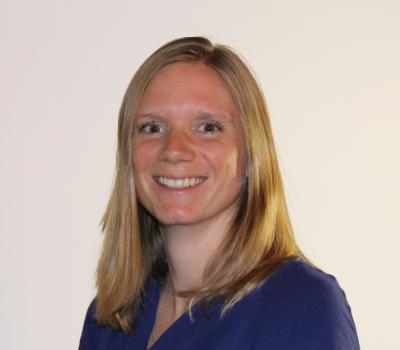
Paula De Szoeke
Assistant Director of Engineering+
Additional Positions
Senior Instructor I
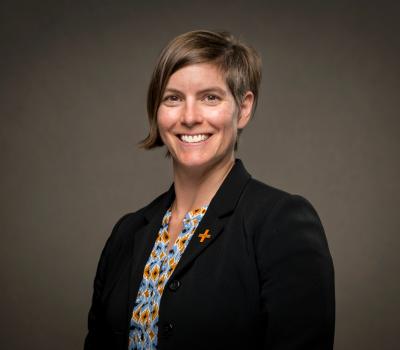
Natasha Lavelle, PhD, P.E.
Director of Engineering+
Additional Positions
Senior Instructor I