
Introduction
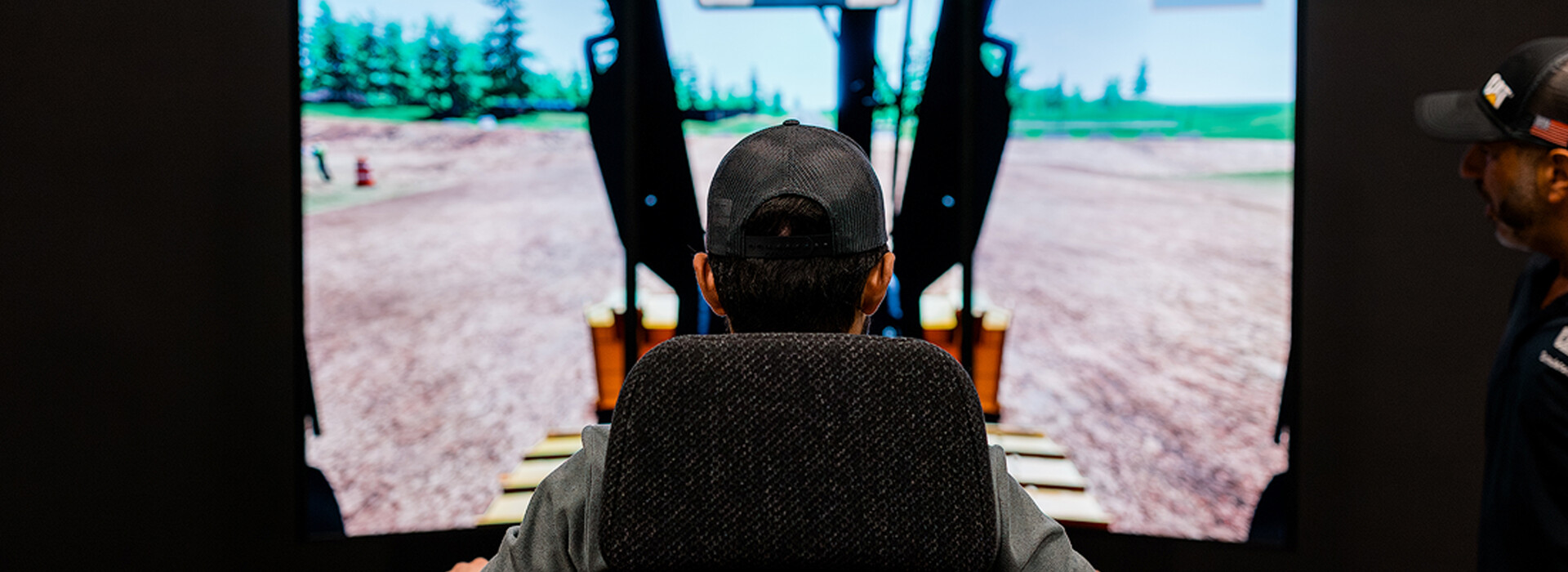
A student sits at the controls of a bulldozer and the machine pitches forward. Nearby, another student walks through an active work zone — and it all happens indoors. This is the Knife River/Everus Construction Safety Lab, a new facility on the Oregon State University campus that is redefining how researchers study safety in some of the most complex and dangerous work environments.
Despite ongoing improvements, construction sites and transportation systems carry risks and it’s nearly impossible to study those risks in the real world.
“A contractor isn’t going to stop a job so we can run an experiment,” said John Gambatese, professor of construction engineering. “And ethically, we can’t expose people to risk just to study it.”
The Knife River/Everus Construction Safety Lab changes that.
professor of transportation engineering and director of the Kiewit Center
Blue Primary, Yellow Secondary
A new approach
Instead of reconstructing safety outcomes after they occur, researchers can simulate environments and study what happens in real-time as people, vehicles, and infrastructure interact.
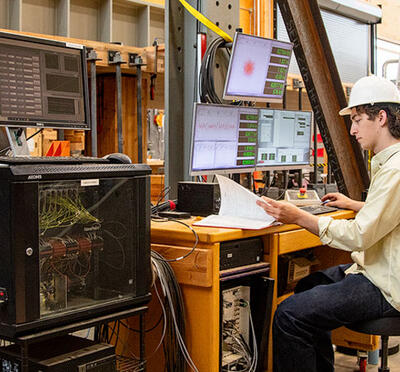
On one side of the lab, high-fidelity simulators replicate construction equipment with realistic controls, motion, and immersive visuals. On the other, a motion-capture and virtual reality space tracks workers and pedestrians in precise detail, showing how they move, where they look, and how they respond to changing conditions.
Together, these systems make it possible to study safety at a level of detail that was previously out of reach.
“In the real world, we’re often trying to reconstruct what happened after an incident,” said David Hurwitz, professor of transportation engineering and director of the Kiewit Center. “In this new lab, we can measure everything — movement, attention, even physiological responses — as it’s happening.”
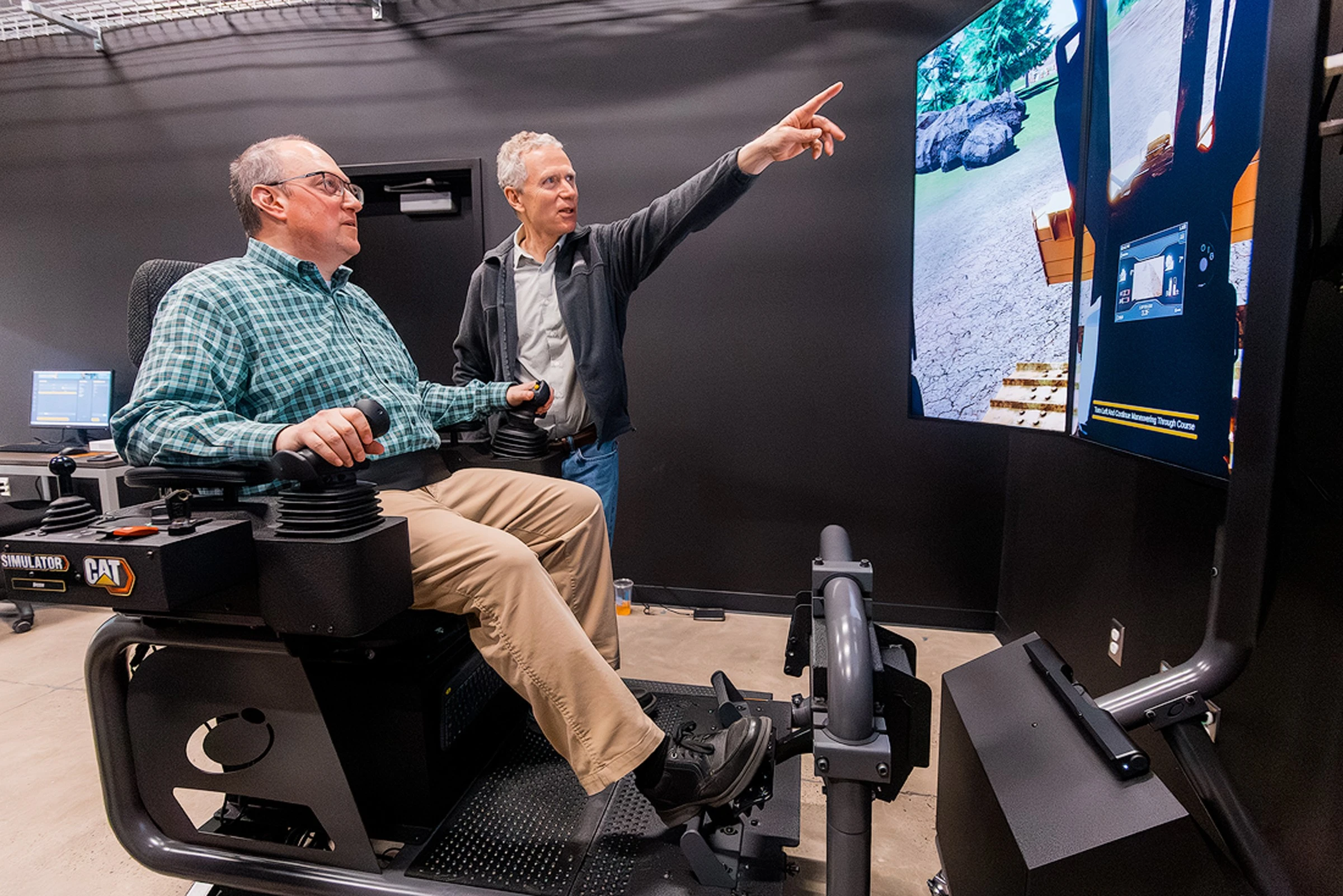
By adjusting variables — such as redesigning a crosswalk, altering a work zone layout, or modifying equipment placement — researchers can compare outcomes and identify which designs lead to safer behavior.
“A big part of what we do is compare alternatives,” Gambatese said. “We can take a design, change it, and see how that affects the people interacting with it.”
And by eliminating the need for physical infrastructure, researchers can test and refine variables quickly and at a fraction of the cost than before.
Learn by doing
Beyond its research potential, the lab also serves as a powerful learning environment.
Graduate students are already developing studies using the facility, while undergraduates are gaining hands‑on experience that bridges theory and practice. Instead of simply calculating how equipment should perform, students can step into a simulator and experience it firsthand — and then connect that experience back to the principles behind it.
Building the lab itself was also an exercise in collaboration.
“It took a lot of people to make this happen,” Hurwitz said. “Faculty, administrators, industry partners — it’s really a shared effort.”
More than six years in the making, the facility was developed with critical support from Knife River, Everus, and the M.J. Murdoch Charitable Trust.
“Collaborating with John Gambatese, our partners, and the college to design and construct this facility was an exceptionally rewarding experience,” Hurwitz said. “We can't wait to lean into new research and leverage these tools with our talented students.”