

Introduction
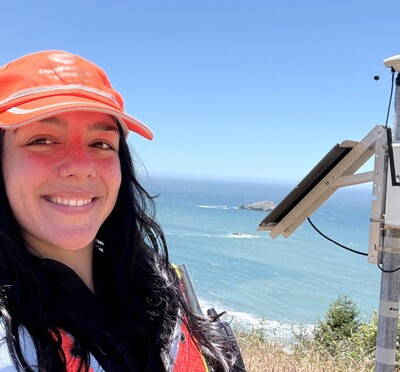
Oregon State University computer science doctoral student Xuan Wu has been selected as a recipient of the 2026 ACM/IEEE CS George Michael Memorial High-Performance Computing Fellowship, one of the most competitive honors for graduate students working in high-performance computing. The fellowship recognizes exceptional Ph.D. students whose research advances high-performance computing, networking, storage, and large-scale data analysis.
Wu was honored for what ACM and the IEEE Computer Society described as “pioneering error-controlled methods for compressing, retrieving, and analyzing scientific data that unlock faster scientific insight from extreme-scale simulations.”
Only three students worldwide received the fellowship this year. Wu joins recipients from King Abdullah University of Science and Technology and the University of Utah. She will be recognized at the international Supercomputing Conference SC26, one of the premier gatherings in high-performance computing.
“This recognition places Xuan’s work in front of the global HPC community and marks her as one of the field’s most promising emerging researchers,” said Wu’s doctoral advisor, Xin Liang, associate professor of computer science.
Tackling the Data Deluge
Working under the guidance of Liang, Wu focuses on one of the field’s fastest-growing challenges: managing the enormous volumes of data generated by modern scientific simulations.
computer science doctoral student
Blue Primary, Yellow Secondary
Advanced computational models used to study everything from weather systems and fluid dynamics to nuclear processes can generate datasets so large that storing and moving them becomes a major obstacle to scientific discovery. Wu’s research seeks ways to dramatically reduce data size while preserving scientific accuracy.
“We’re in an era of exploding data,” Wu said. “Everything is growing in volume very rapidly. For scientific applications and AI applications, the pressure created by data continues to increase. Finding ways to manage that data and reduce that pressure is going to remain an important challenge.”
Wu’s work centers on error-bounded compression, a technique that allows researchers to specify how much deviation from the original data is acceptable. Compression algorithms can then reduce storage requirements dramatically while ensuring that reconstructed data remains within strict accuracy limits.
The approach is particularly effective for scientific simulations because neighboring data points often exhibit predictable relationships and patterns.
“We try to take advantage of those correlations when designing compression methods,” Wu said. “That allows us to reduce data size significantly while still preserving the information scientists need.”
An Unexpected Honor
Wu said receiving news of the fellowship came as a surprise.
“I felt very honored,” she said. “I really wasn’t expecting to receive the fellowship this year, so it was a big surprise when I learned I had been selected.”
She noted that the fellowship’s emphasis on high-performance computing and large-scale data analysis closely aligns with her research interests and long-term goals.
Wu also credits much of her success to the mentorship she has received from Liang, whom she first contacted while seeking a Ph.D. advisor. Wu began working with Liang at the University of Kentucky before following him to Oregon State last year when Liang joined the faculty.
“My advisor has put a tremendous amount of effort into helping me develop these projects and creating opportunities for me to make progress and discover new directions,” Wu said.
Looking Ahead
Wu is a member of the HiPCastor (High-Performance Computing and Systems) group at Oregon State, whose students have led a strong record of publications in 2026, including three IPDPS papers, one ICS paper (Best Paper Award nominee), one HPDC paper, and two SC papers. Her fellowship reflects the group’s commitment to supporting Ph.D. researchers who tackle the field’s most pressing challenges, and highlights the rapid rise of high-performance computing research at OSU, which ranks 13th in the U.S. in HPC research according to CSRankings, based on publications over the past decade.
As she continues her doctoral studies, Wu is enthusiastic about Oregon State’s growing high-performance computing ecosystem, including the advanced computational resources coming to the Jen-Hsun Huang and Lori Mills Huang Collaborative Innovation Complex. Those capabilities, she said, will provide new opportunities for research involving GPUs and large-scale computing.
Wu hopes to pursue a postdoctoral or faculty position after graduation, continuing her efforts to develop technologies that help scientists manage, analyze and learn from ever-growing datasets.