
Introduction
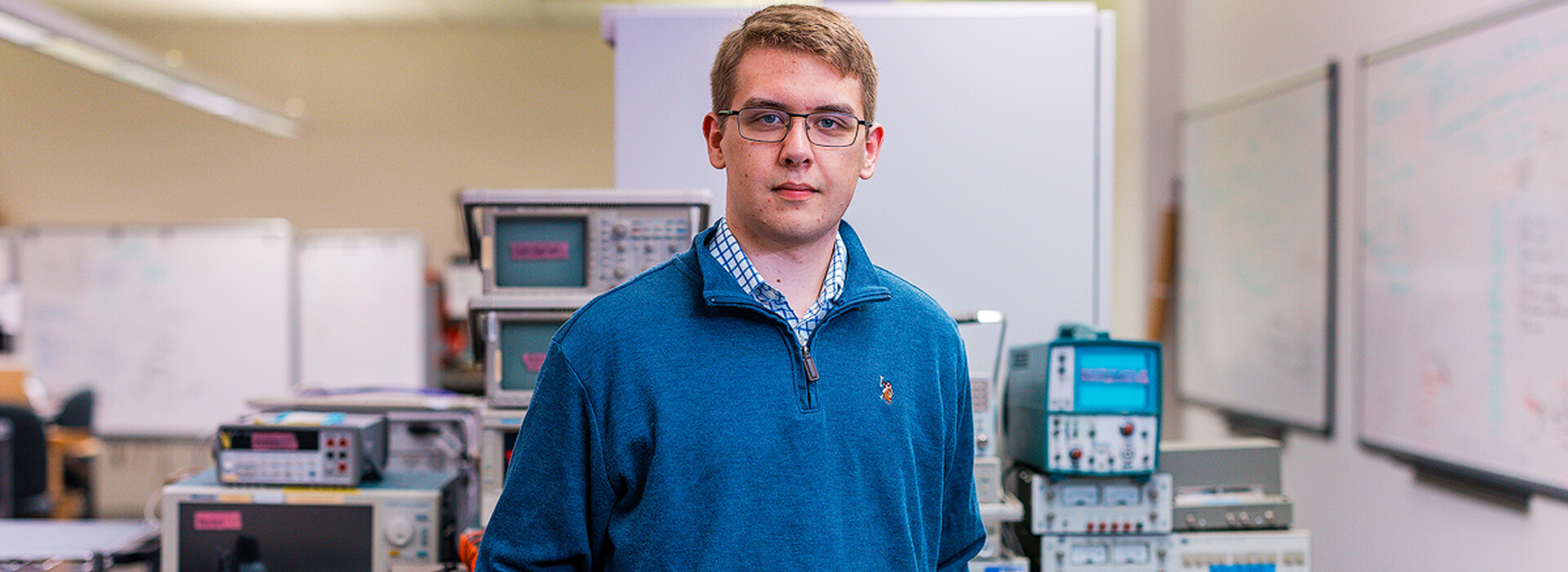
As quantum computing races from theory toward practical reality, John Fletcher is helping Oregon State University carve out a place in the field. The master's student in electrical and computer engineering is leading research on integrated circuits designed to control transmon qubits, a common type of quantum computing element. The project represents some of OSU's first quantum computing-related work in integrated circuit design, placing Fletcher at the forefront of an emerging area of research on campus.
That work, combined with his accomplishments in analog and mixed-signal integrated circuit design, recently earned Fletcher selection to the Semiconductor Research Corporation (SRC) Scholars Program, which provides financial support and industry connections for promising graduate student researchers.
"It's a great feeling to have your work recognized," Fletcher said. “It shows that the work you're doing is meaningful and helps push technology forward.”
master’s student in electrical and computer engineering
Blue Primary, Yellow Secondary
From aviation enthusiast to IC designer
Fletcher's path to advanced semiconductor research was not always obvious. In high school, he was more focused on music than engineering and originally planned to study jazz performance. But an interest in aviation led him to explore radar systems, sensors, and eventually integrated circuits.
When it came time to choose a university, Oregon State offered both personal and academic connections. His mother studied electrical engineering at OSU in the 1990s, his family was in the process of relocating to Oregon, and the university's strengths in integrated circuits and radio frequency engineering aligned with his interests.
At OSU, Fletcher quickly found a home in the School of Electrical Engineering and Computer Science. He conducted undergraduate research in the Applied Magnetics Lab, where he worked on microwave magnetics, RF systems, and phased-array technologies.
But as his studies progressed, his interests shifted toward integrated circuits. After taking an electronics course, Fletcher became fascinated by the challenges of IC design and sought opportunities in the Mixed Signal Circuits and Systems Lab, run by Tejasvi Anand, associate professor of electrical and computer engineering.
"I really enjoyed integrated circuits and the types of problems involved," Fletcher said. “There are a lot of incredibly difficult problems to be solved, and Dr. Anand's lab has a history of tackling some of the hardest ones.”
An industry-focused future
Fletcher had long planned to pursue a master's degree through the College of Engineering’s Accelerated Master's Program. During his freshman year, he was already looking ahead to graduate courses in CMOS design, phase-locked loops, and advanced communications systems.
"The graduate courses were really the ones I was most interested in," he said. "That was the material I wanted to be able to tackle."
Now, under Anand's guidance, Fletcher is helping design a chip intended to control transmon qubits. The team plans to tape out the chip later this year before expanding into other quantum computing and integrated circuit challenges. Because quantum IC research is still relatively new at OSU, the work carries special significance.
master’s student in electrical and computer engineering
Blue Primary, Yellow Secondary
Beyond the laboratory, Fletcher gained valuable industry experience this summer as an analog IC design intern with Texas Instruments in Tucson, Arizona. He landed the internship after presenting his research plans and qubit-control work at the Center for Design of Analog Integrated Circuits (CDADIC) conference, where industry representatives took notice.
At Texas Instruments, Fletcher has worked on high-speed operational amplifiers, an experience that closely mirrors his research activities at Oregon State.
"My day-to-day work with TI has been circuit design," he said. “I work on schematics, run simulations, test different architectures, and do theoretical analysis. It's very similar to the research I’m doing at OSU.”
Looking ahead, Fletcher hopes to pursue a Ph.D. and continue working at the cutting edge of integrated circuit design, whether in quantum computing, high-speed data converters, phase-locked loops, or serial communications systems.