Introduction
When a pollutant seeps into a riverbed, or engineers try to coax critical minerals out of underground rock, the outcome is decided at the smallest scales: water squeezing between grains of sediment, chemicals mixing unevenly in the countless gaps among pebbles and sand grains large and small. Capturing those processes in computer models presents scientists with a fundamental problem: The most detailed simulations are far too computationally expensive to run at the scale of an aquifer, geothermal reservoir, or other large subsurface system.
A team led by Sourabh Apte at Oregon State University is using artificial intelligence to bridge that gap through a funding award from the U.S. Department of Energy’s Genesis Mission. The nine-month project brings together researchers in fluid mechanics, artificial intelligence, chemical engineering, and subsurface science at Oregon State and Pacific Northwest National Laboratory.
The team’s goal is to improve PFLOTRAN, a simulation platform used to predict the movement of water, heat, chemicals, and microorganisms through underground environments. Timothy Scheibe, Laboratory Fellow in the Integrated Discovery Sciences Directorate at PNNL, together with a team of researchers at PNNL, will help the researchers incorporate their AI-enhanced models into PFLOTRAN and determine whether the models can accurately represent small-scale processes without simulating every pore.
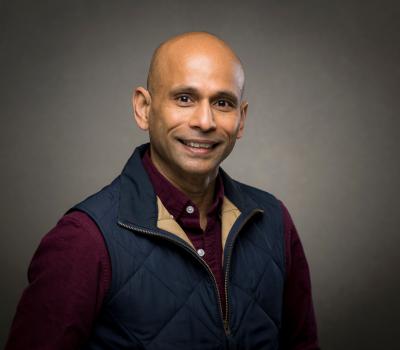
“This is fundamentally a multiscale problem,” said Apte, professor of mechanical engineering.
Teaching AI to learn from costly simulations
Because modeling every pore becomes impractical when researchers want to predict behavior across meters or kilometers, or over longer periods, the team’s goal is to use detailed simulation data to develop improved mathematical relationships, known as closure models, that carry information from the pore scale into computationally efficient, larger-scale models.
professor of mechanical engineering
Blue Primary, Yellow Secondary
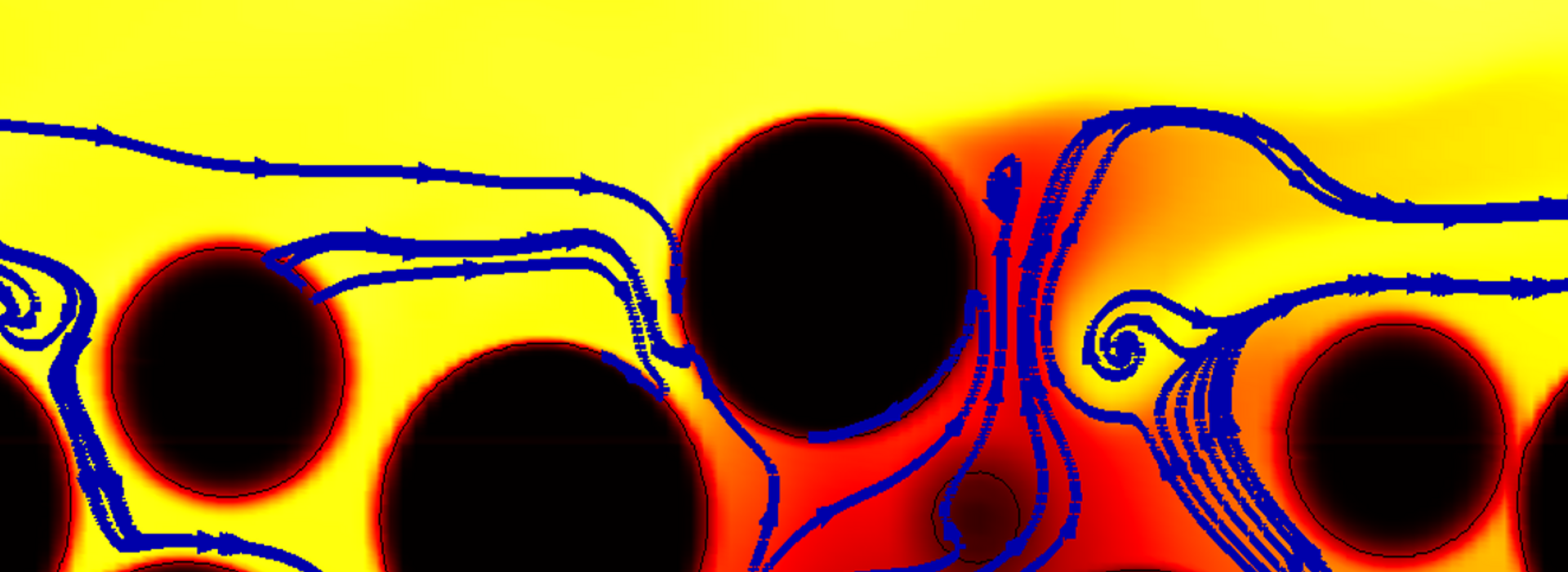
Jesse Rodriguez, assistant professor of mechanical engineering and the Nesbitt Faculty Scholar in Energy Engineering, leads the project’s AI work. His raw material is terabytes of extreme-scale simulation data of turbulence in and around porous beds from Apte’s group, including graduate students Daniel Furst and Phurin Nilket. Think of a pile of sand, Rodriguez said: countless objects packed together, with tiny spaces through which fluid moves.
Each case, meaning one full simulation of fluid moving through a packed bed of grains under a single set of flow conditions, can take 50,000 node-hours. “In fluid mechanics, these simulations are almost treated as ground truth, because they’re an extremely precise numerical simulation of the governing equations,” Rodriguez said.
Rodriguez and graduate student Noah Harris will train a neural network to recognize what is lost when those detailed calculations are replaced by a faster, simplified model. Using information about the overall flow and characteristics of the porous material, the AI will estimate the missing values the larger-scale equations need. The resulting model will be incorporated into PFLOTRAN, with the goal of producing results similar to the full simulations much more quickly.
Training the AI presents its own challenge, as each expensive simulation represents only one set of physical conditions.
“We have a very large number of labeled data points, but they all sit under the umbrella of only a few flow regimes,” Rodriguez said. The researchers will supplement those data with less expensive simulations representing additional conditions. Because the AI model will operate inside a scientific simulation, he added, “we’ll design it so that it’s always obeying physics.”
Experiments anchor the models in reality
Lazaro Perez, assistant professor of civil engineering, provides an important connection to the physical world. His previous experiments have used synchrotron-based micro-computed tomography to visualize pore-scale movement and identify mixing “hot spots” that can influence chemical reactions. His contribution will be ensuring the team’s simulations stay true to experimental data.
“Experiments reveal how fluids behave within these complex pore networks,” Perez said. “Simulations help us interpret and predict that behavior, but they involve assumptions that are derived from experimental observations.” Experiments can also uncover processes models miss and test how accurately simulations reproduce physical systems."
Perez compares the scale problem to predicting traffic across an entire city by observing intersections in one neighborhood. Tracking individual cars reveals how local streets and traffic lights affect movement, but citywide predictions must account for many connected neighborhoods and bottlenecks.
“In a porous material, fluids move through a network of pores instead of streets,” Perez said. “Our challenge is to understand how those local movements combine to control transport and reactions across a much larger region.”
A competitive win built on a strong partnership
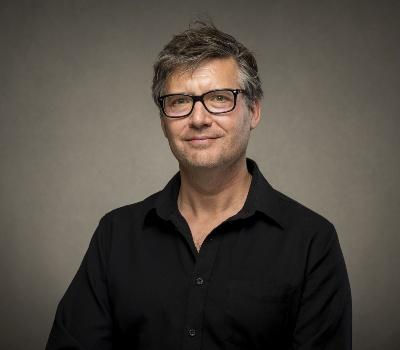
Laboratory Fellow in the Integrated Discovery Sciences Directorate at PNNL
Blue Primary, Yellow Secondary
Most of the AI training will take place at the Argonne Leadership Computing Facility, where the simulation data are stored and where Rodriguez has a computing allocation. The team may also use Oregon State’s NVIDIA supercomputer, scheduled to come online in early 2027 in the Jen-Hsun Huang and Lori Mills Huang Collaborative Innovation Complex, for AI training and model development.
For Oregon State, the Genesis Mission award represents a significant milestone. Apte said the first round attracted more than 5,000 proposals, with only about 275 selected.
“It’s very competitive, especially in our field, which is a fairly mature field in fluid dynamics and transport phenomena,” he said. “It feels really good to be selected.”
The established relationship between Oregon State and PNNL strengthened the proposal. Several of Apte’s doctoral students have worked at the Laboratory, giving the team “an edge in terms of an established collaboration, which is what DOE was looking for,” Apte said.
“OSU is one of PNNL’s primary academic partners,” Scheibe said. “It’s a really fruitful partnership between our two institutions, and this is just one small piece of that.”
For Scheibe, the project is long-awaited. “We’ve been working on this multiscale closure problem for three decades and never made a huge amount of progress,” he said. A 2021 paper co-written by Oregon State professor Brian Wood, who is another collaborator on the project, which used AI to model blood flow in human tissue, helped convince Scheibe that the approach could also work in porous media like riverbeds and aquifers.
The next few months will move fast. Success at the project's midpoint review means showing that AI-derived closures work in PFLOTRAN for permeability and dispersion. That would set up a larger, multi-year Phase II project focused on chemical and microbial reactions, in collaboration with an industry partner.