Introduction
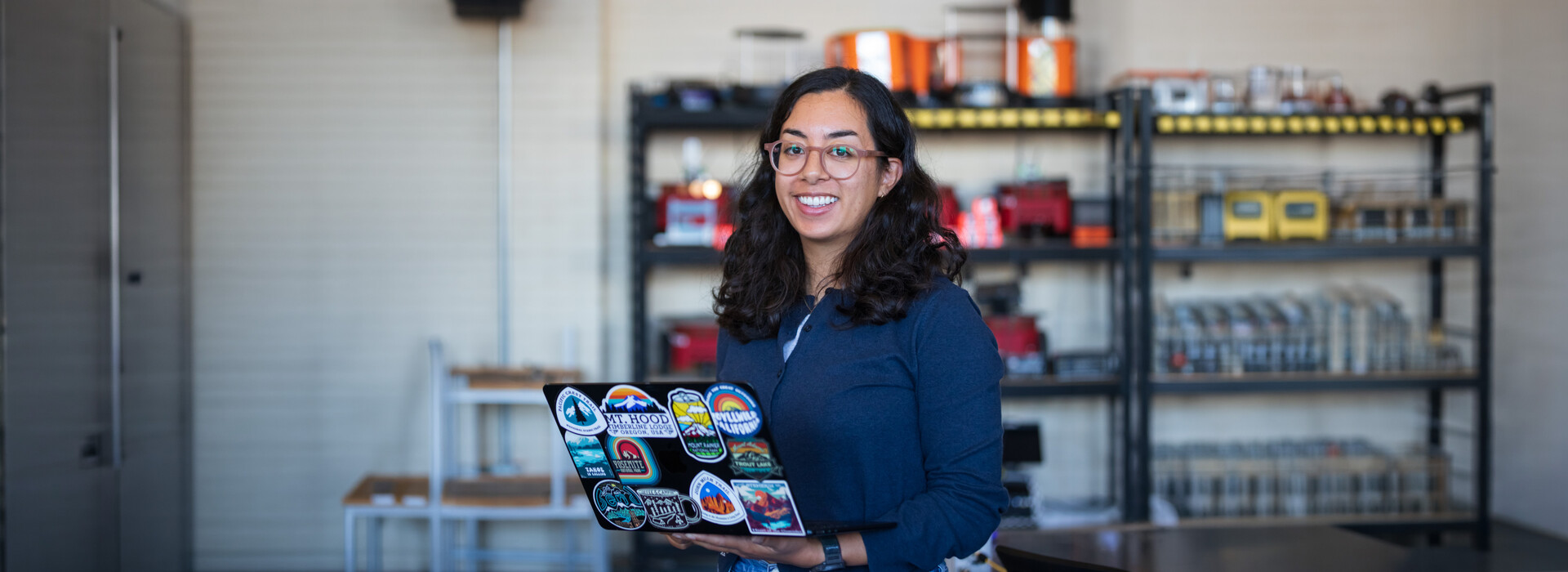
When Jamie Santos set out to hike the Pacific Crest Trail in 2025, she was embarking on an adventure she had dreamed about for eight years. She knew where she wanted to end up, but she also understood that circumstances could force plans to change. Her goal, she wrote just before starting, was to keep moving toward Canada for as long as she could.
Now a robotics doctoral student at Oregon State University, Santos is tackling a surprisingly similar problem: How can teams of robots pursue goals on the moon and Mars when conditions, priorities, and even the capabilities of the robots themselves can change?
Her project, “Dynamic Multi-Objective Prioritization for Autonomous Robot Teams on the Moon and Mars,” is supported by a four-year NASA Space Technology Graduate Research Opportunities award. The program supports graduate students pursuing innovative space-technology research at their universities and NASA centers, pairing each researcher with a NASA subject matter expert.
Preparing robots for the unexpected
In the lab of Kagan Tumer, professor of robotics and director of the Collaborative Robotics and Intelligent Systems (CoRIS) Institute, Santos studies multi-agent coordination, particularly how groups of robots can learn coordinated behaviors while pursuing multiple objectives.
PhD student in robotics
Blue Primary, Yellow Secondary
A search-and-rescue robot, for example, might need to balance covering a large area quickly against conducting a slower, more thorough search. Instead of defining the preferred approach in advance, Santos wants robots to learn a range of solutions they can draw upon as circumstances and priorities change, and then autonomously change course when needed in the field.
That flexibility could be particularly important for robots operating on other worlds, where robots may face conditions their designers cannot fully anticipate.
“The moon and Mars have very dynamic, unstructured environments,” she said. “How can we make sure the policies these robots implement are robust if, say, one of its teammates goes down or maybe it’s lost a sensor?”
Her longer-term goal pushes autonomy further: enabling robots to choose among those different approaches on their own.
“How do robots autonomously decide, ‘This is what matters to me’?” she said. “That’s a very open-ended question that hasn’t been addressed yet.”
Finding her way to space robotics
Santos’ path began with a high school engineering club. As an electrical engineering student at the University of Washington, she participated in the Mars Rover Club and Husky Satellite Club before working in embedded systems after graduation.
She later pursued a master’s degree in Sweden and completed her thesis research at NASA Ames Research Center, where she developed an approach using 3D point clouds to help robots autonomously detect changes in space habitats, including NASA’s Astrobee free-flying robot, as part of the agency’s Integrated System for Autonomous and Adaptive Caretaking (ISAAC) program.
She subsequently worked as a robotics research engineer at Texas A&M before taking several months to hike the Pacific Crest Trail and then beginning her doctoral studies at Oregon State. Her months on the trail reinforced a simple lesson she now carries with her: Keep going even when the route ahead is uncertain.
Her attraction to robotics rests on much the same uncertainty. The field, she said, remains far from the possibilities people can imagine for autonomous machines.
“Robots are not anywhere near where they can be if you use your imagination,” Santos said. “There’s a lot of room for growth and opportunity. A lot of it hasn’t been done yet, and it’s exciting to get to work on it.”