
Introduction
When Cole Jetton began his doctoral studies in mechanical engineering at Oregon State University, he wasn’t content to simply make machines work better — he wanted to rethink how engineers design them. His Ph.D. research centered on integrating artificial intelligence into the design process, creating tools that help human engineers solve complex, large-scale problems more effectively.
“I wanted to find ways for AI to enhance — not replace — human creativity in engineering,” said Jetton, who graduated this summer and recently began a post-doctoral position at Uppsala University in Sweden, where he’s applying AI to the field of additive manufacturing. “The idea was to have AI suggest pathways or parameters but still rely on human judgment and intuition.”
Flipping the AI design process on its head
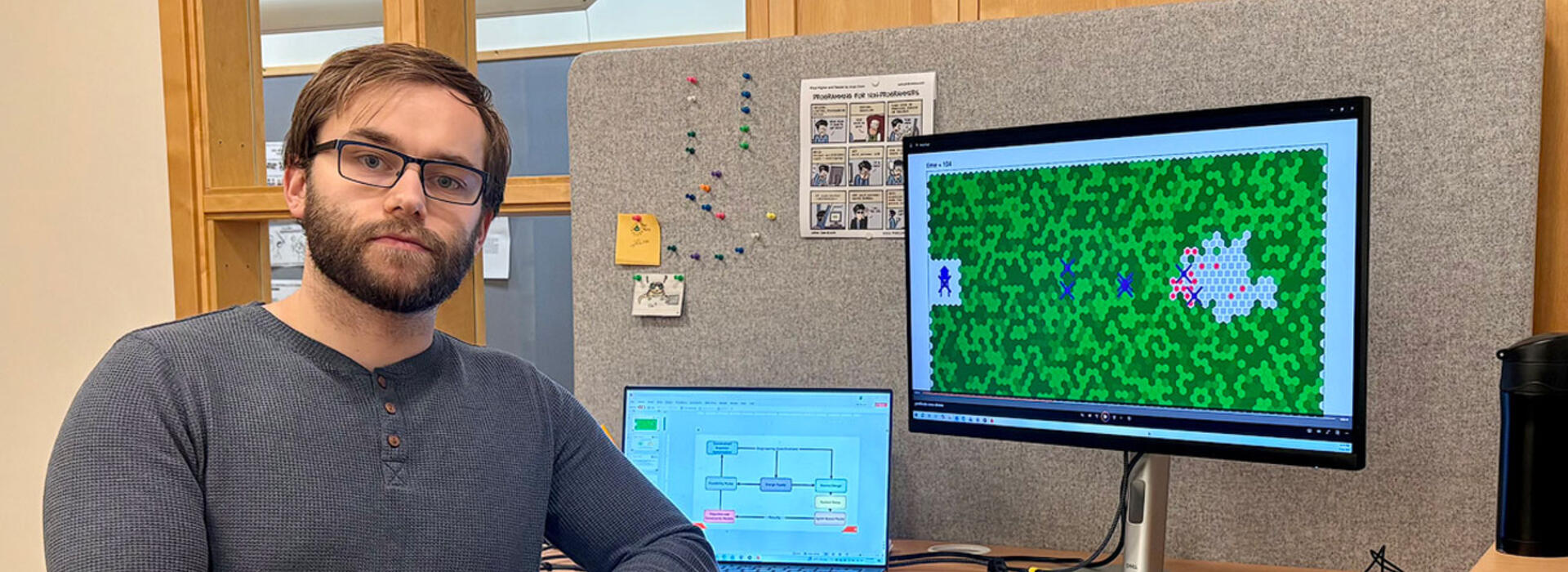
Working under Matthew Campbell, professor of mechanical engineering, and Christopher Hoyle, associate professor of mechanical engineering, Jetton developed a computational framework that combines human expertise with Bayesian optimization and agent-based modeling. These methods enable engineers to simulate and test fleets of small, cooperating devices before they are physically built.
Campbell described Jetton’s work as “an example of how Oregon State engineers think about solving grand challenges without necessarily solving them directly.” He explained that their research wasn’t about building a specific device, but about developing better ways to design systems.
Ph.D. mechanical engineering ’25
Blue Primary, Yellow Secondary
Jetton’s research flips the typical AI design process on its head. Instead of relying on a computer to generate design ideas for humans to evaluate — a method often limited by the AI’s training data — Jetton’s method uses machine learning to guide the human expert.
“We’re using AI not just to automate parts of design,” Campbell said, “but to collaborate with engineers — to leverage what the computer is best at, like logistics and optimization, and what humans are best at, like understanding materials and real-world constraints.”
This collaboration between human and machine was tested in Jetton’s experiments, where upper-level engineering students designed simple prototypes from crafting materials (e.g. popsicle-sticks, foam balls, etc.) that modeled drones and small wheeled robots — under “AI-guided” and “unguided” conditions.
“The guided group, which had AI suggestions, generally performed better without losing creativity,” Campbell said. “That’s important, because one fear in the community is that automation could stifle innovation.”
Oregon State balances hands-on experience and cutting-edge theory
Jetton’s research began at Loyola Marymount University, where Jetton earned his bachelor's degree in mechanical engineering. His early experiences included materials research, work on an inertial electrostatic confinement fusion project, and hybrid rocket research. After graduating in 2019, he came to Oregon State through a remote summer research program during COVID-19. The experience helped the Portland native see Oregon State as the ideal environment to pursue his ideas.
“OSU has this balance of hands-on experience and cutting-edge theory,” he said. “The faculty encouraged me to explore intersections between engineering design, computation, and human behavior.”
The university also gave him freedom to be ambitious. “When I first said I wanted to apply AI to design theory, it was still a relatively new concept in mechanical engineering,” Jetton recalled. “But my advisors said, ‘Let’s make it happen.’ That openness was huge for me.”
Using human-AI collaboration to solve global challenges
Throughout his doctoral journey, Jetton published several papers with his advisors, including studies presented at major ASME conferences. His research contributed to a growing understanding of how human-AI collaboration can improve design outcomes for global-scale challenges, including ocean cleanup, reforestation, or firefighting with drones.
Consider the firefighting drone example. “You have this interesting trade off where you can build a large drone with a long range. It can carry a lot of fire suppressant, but you can't afford as many,” Jetton said. “Alternatively, you could build smaller drones that can't carry as much suppressant, but you can have a much larger fleet.”
The optimal solution lies somewhere in between. But finding the best size and all the engineering details that fulfill that size constraint would require running complicated simulations that account for variables humans struggle to grasp intuitively.
“These are problems where the stakes are high and the systems are huge,” he said. “We need tools that help us see the trade-offs between cost, performance, and feasibility across entire fleets of devices, not just single machines.”
As he looks ahead, Jetton hopes to continue exploring how AI can shape the future of engineering design, whether in academia or industry. “I want to keep building systems that make engineers more capable and creative,” he said. “The goal is to use AI not as an answer machine, but as a thinking partner.”
For Jetton, that partnership is just beginning. “We’re only scratching the surface of what AI and engineering can do together,” he said. “If we get it right, we can design solutions to some of humanity’s toughest challenges.”