
Introduction
Despite decades of investment in digital tools, many of the most important decisions in construction are still made the same way they always have — on the fly, in the field, based on experience.
“Construction is one of the hardest systems to plan and perform,” said Joseph Louis, associate professor of construction engineering at Oregon State University. “A lot of what actually happens on site is still decided by gut feeling.”
That reliance on intuition, Louis argues, isn’t a failure of expertise — it’s a symptom of a deeper problem. Construction projects unfold in uncontrolled, constantly changing environments, with crews, equipment, and materials interacting in ways that are hard to predict. Existing tools for scheduling, enterprise management, and building information models (BIM) tend to capture plans and designs, but not the dynamics of field operations themselves.
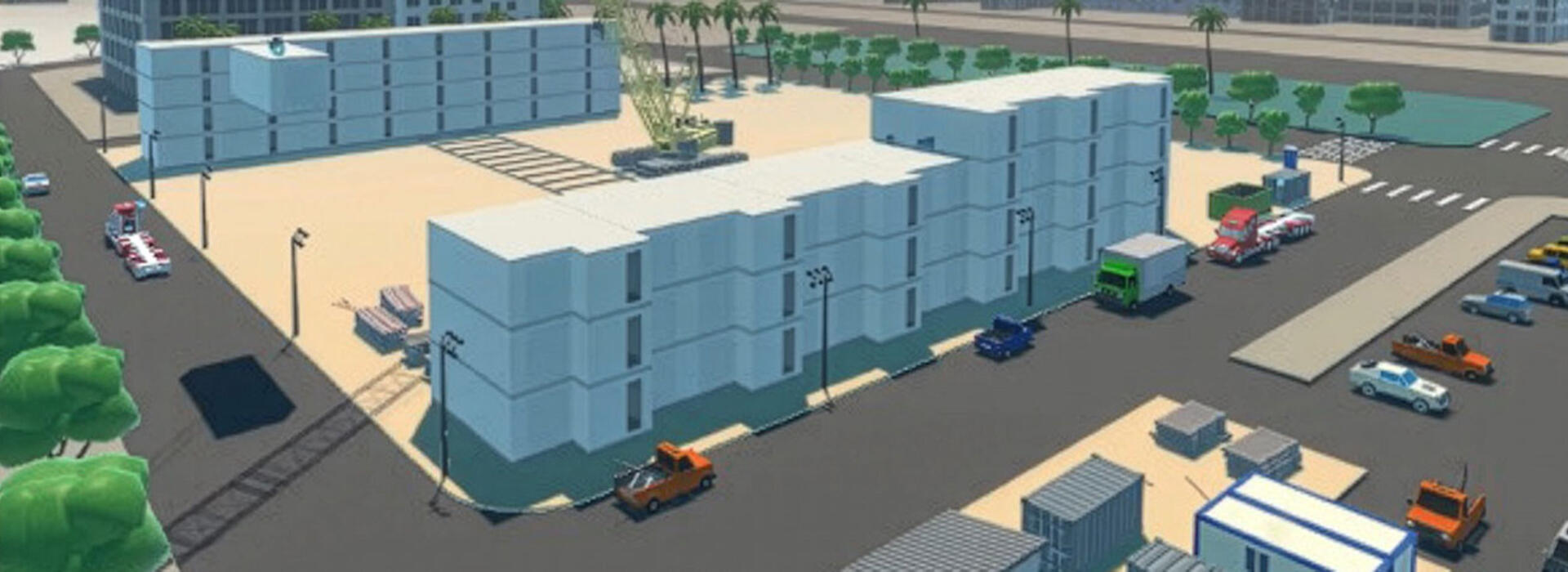
To address that gap, Louis developed ConStrobe, short for Construction Operations Simulation for Time and Resource‑Based Evaluations. The platform allows users to model construction operations as dynamic production systems and to test decisions virtually before committing resources in the real world.
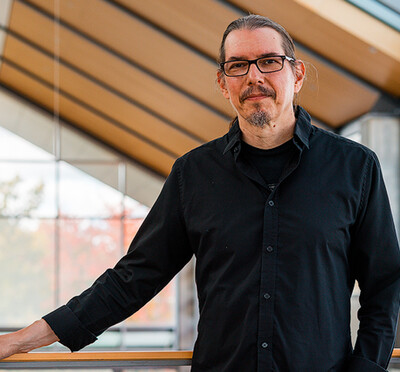
associate professor of construction engineering
Blue Primary, Yellow Secondary
Why simulation fits construction
Louis’s work builds on long‑standing research showing that discrete‑event simulation is uniquely suited to construction. Unlike manufacturing, where processes are standardized and controlled, construction work is highly variable, interdependent, and sensitive to disruptions. Small delays can cascade, equipment can sit idle while crews wait, and productivity can shift dramatically based on resource choices.
“Most of the software we use today lives in the office,” Louis said. “But construction actually happens in the field. That’s where simulation really fits.”

ConStrobe is designed to model those field‑level realities. Users represent operations as networks of activities, queues, and resources, then run simulations repeatedly under uncertainty. Instead of a single predicted outcome, the platform produces distributions of results, showing how different strategies affect time, resource utilization, and bottlenecks.
“You’re not trying to predict the future,” Louis said. “You’re trying to understand the system and evaluate alternatives objectively under uncertainty.”
How ConStrobe is built
What sets ConStrobe apart from earlier construction simulation tools is its emphasis on automation and integration with existing data and workflows. Louis wanted a system that could scale to realistic problems and plug into the digital ecosystem construction teams already use.
One key feature is support for distributed simulation through the IEEE High‑Level Architecture (HLA) standard. That allows multiple simulations — representing different sites, depots, or subsystems — to interact in a coordinated way, rather than being modeled in isolation. This would allow models of basic processes to be reused for multiple projects in combination with each other — much like work that actually happens on the job site.
Equally important is ConStrobe’s Python‑based automation. Using a Python library, users can parameterize models, connect them to external data sources such as BIM and GIS, and run large batches of scenarios automatically.
“Once the simulation is set up, you can treat it almost like a function,” Louis said. “You feed it data and see how the operation might unfold.”
In research demonstrations, ConStrobe has been linked to GIS maps to simulate debris removal at heavy civil operations after disasters, and to BIM models evaluate equipment and crew configurations on building construction projects.
Who it’s for—and why it matters
ConStrobe is aimed at advanced practitioners, researchers, and organizations facing complex operational decisions where intuition alone isn’t enough. Louis is clear that the tool is not meant to replace experience.
“Seasoned field engineers have incredible intuition,” he said. “Simulation gives them a way to test that intuition, see how delays propagate, and understand the trade‑offs they’re making.”
Looking ahead, Louis sees simulation as complementary to artificial intelligence, providing the structured, scenario‑based data needed for optimization in highly constrained and dynamic environments like construction.
“Simulation is the best of both worlds,” he said. “You get realism without the cost of real‑world experimentation.”