
Introduction
Some partnerships are transactional. Others are transformational. The relationship between The Boeing Company and Oregon State University's College of Engineering falls squarely in the second category. The decades-long collaboration is rooted in a shared conviction that great engineers are made through rigorous education, hands-on experience, and meaningful industry mentorship.
Year after year, Boeing returns to OSU as an invested partner, contributing financially, intellectually, and professionally to programs and students across the college. That sustained commitment, formalized through the COE Corporate Partners Program, places Boeing among a select group of industry leaders whose annual support directly funds the infrastructure of undergraduate and graduate engineering education at OSU.
A Foundation of Long-Standing Commitment
The OSU-Boeing partnership is not measured in months or single fiscal years — it is measured in generations of engineers. Boeing's long-standing involvement with the College of Engineering has created a durable pipeline between Corvallis and the aerospace and defense sectors, ensuring that OSU graduates enter the workforce already familiar with Boeing's culture of precision, safety, and innovation.
At the heart of this relationship is an annual investment that touches virtually every corner of the college. Boeing's contributions support faculty research, program development, and the kind of capital improvements that make a real difference in the student experience. For students pursuing careers in aerospace systems, avionics, structures, autonomous vehicles, or advanced materials and manufacturing, Boeing's presence within the college signals something important: the skills being developed in OSU labs are the same skills being deployed on the production floors of one of the world's most complex engineering enterprises.
Investing in Students: Scholarships, Clubs, and Co-Curricular Excellence
Boeing understands that the most meaningful investment in the future of engineering is an investment in engineers themselves. Through scholarship support directed at OSU students, Boeing helps reduce financial barriers for high-achieving students who might otherwise struggle to complete their degrees. These scholarships are more than financial awards — they are a signal that a company of Boeing's stature sees potential in OSU's student body and is willing to put resources behind it.
director of student engagement
Blue Primary, Yellow Secondary
Beyond the classroom, Boeing's fingerprints are visible across OSU's rich ecosystem of student organizations. The American Institute of Aeronautics and Astronautics (AIAA) chapter, the Society of Automotive Engineers (SAE), and the Robotics Club all benefit from Boeing's ongoing co-curricular support. These programs give students the space to apply classroom theory to real-world design challenges — building rockets, racing vehicles, autonomous systems — while developing the teamwork, project management, and communication skills that define career-ready engineers.
The Leadership, Empowerment, and Purpose program reflects Boeing's understanding that technical excellence alone does not make a great engineer. Leadership, ethics, cross-functional communication, and professional identity are equally essential. Boeing's support for this program ensures that OSU students graduate not just as specialists, but as leaders capable of navigating complex organizations like Boeing itself.
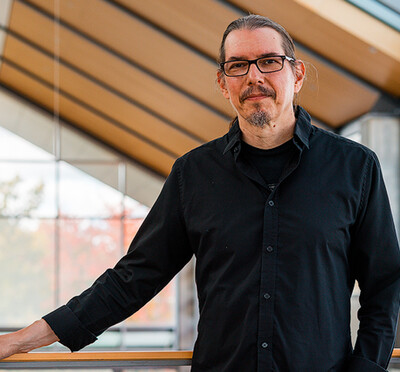
“Boeing has become a central partner in LEAP by investing not only in the program itself, but directly in our students,” said Melissa Ward, director of student engagement, who manages LEAP. “Through mentorship, industry engagement, and experiences like our annual Seattle Industry Trek, Boeing helps students build meaningful connections between their education and future careers. Those relationships help students strengthen their leadership, expand their professional networks, and better understand the impact they can have as future engineers and leaders.”
Workforce Development and the MECOP Advantage
Perhaps nowhere is Boeing’s impact on OSU students more tangible than through the Multiple Engineering Cooperative Program, better known as MECOP. One of the Pacific Northwest’s most respected engineering co-op programs, MECOP places OSU students in two six-month paid industry rotations before graduation — and Boeing is among its most prominent employer partners.
This past year, MECOP students at Boeing were not observing from the sidelines — they were embedded in real engineering work, contributing to projects that directly support aircraft production, systems optimization, and manufacturing efficiency.
computer science student
Blue Primary, Yellow Secondary
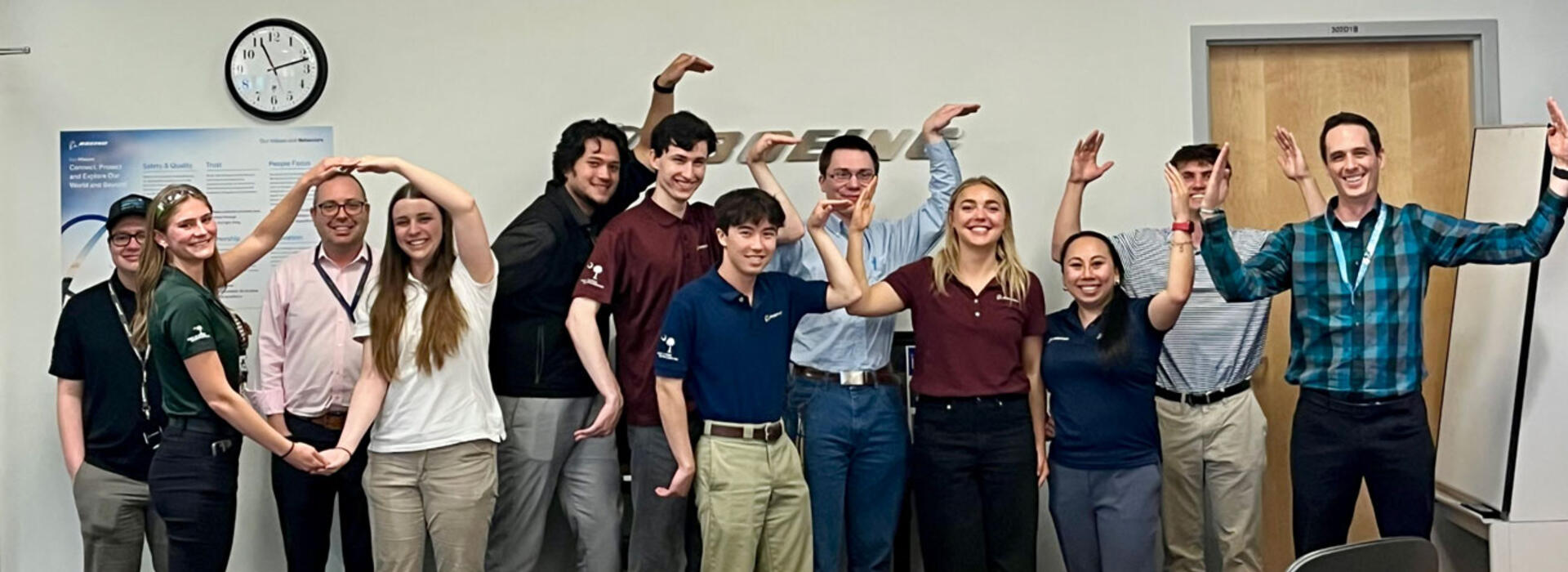
“I had a great roundtable discussion and time connecting with our OSU MECOP Boeing Engineering interns getting amazing experiences in Boeing South Carolina,” said Jason Stoller, Director of Engineering, Interiors Responsibility Centers, Boeing South Carolina, who was joined by Equipment and Tool Engineer Gabriella McVicker, B.S. mechanical engineering ’25, in acclimating the MECOP interns this past year. “I was incredibly impressed by these Oregon State University Engineering student interns shaping their careers with real world experiences working on airplanes. The cohort had fun showing their student university pride together as OSU Beavers.”
For many mechanical engineering students, that work centered on a project known as “Simplified Work Instructions,” an effort to improve how frontline mechanics build safe and conforming aircraft. Working in teams, interns analyzed existing instructions, collaborated with engineers and technicians on the shop floor, and redesigned those materials to make them clearer, more visual, and easier to follow, all with the goal of assisting mechanics to improve first-pass quality.
“It involved going to the shop floor, talking to the mechanics, and asking them what would make their jobs easier,” said Felix Klein, a mechanical engineering student who interned with Boeing in Everett, Washington. “We looked at the instructions they use to build the airplane and then worked to simplify them and add graphics so they’re easier to follow.”
Other students contributed through data and systems-focused roles, working alongside analytics teams to improve how Boeing tracks performance and manages large intern cohorts. One student described helping build reporting tools and data pipelines to give managers clearer insight into operations and team productivity.
Across disciplines, the common thread was responsibility. MECOP interns weren’t completing hypothetical assignments — they were solving real problems inside a complex industrial system.
For students, that level of engagement is transformative. It provides not only technical experience, but also a sense of purpose and belonging within the profession.
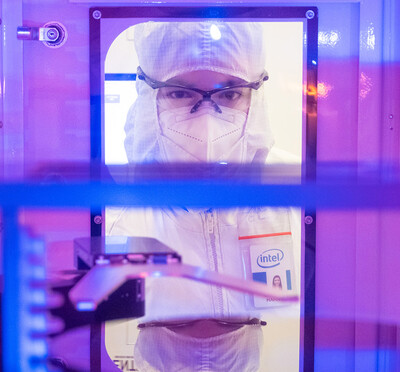
For Chris Hanratty, a computer science student who interned with Boeing in North Charleston, South Carolina, the experience was deeply meaningful, offering both professional growth and personal clarity. “My Boeing internship was one of the best work experiences I’ve had in my entire life,” he said. “Just everything — from the people to the work — was outstanding.”
That sentiment echoes across the MECOP cohort. Students return to campus with more than new skills — they come back with confidence, industry perspective, and a clearer understanding of how their education connects to real-world impact.
Beyond Engineering: Career Development Through the College of Business
Boeing's investment in OSU students extends beyond the engineering quad. Recognizing that today's engineers must be as fluent in business fundamentals as they are in thermodynamics or signal processing, Boeing has also extended its support to career and professional development programming through OSU's College of Business. This cross-college engagement reflects a sophisticated understanding of what it takes to thrive in modern industry — and ensures that OSU graduates are prepared not just to do technical work, but to lead it.
A Partnership Built on Shared Purpose
In an era when industry-university relationships can be fleeting or narrowly transactional, Boeing's commitment to Oregon State's College of Engineering stands out for its breadth and durability. It is a partnership that invests in programs, not just projects, and in people, not just pipelines. From the first-year student receiving a Boeing-funded scholarship to the final-year student returning from a MECOP rotation with a full-time offer in hand, the impact of Boeing's annual support is felt at every stage of the OSU engineering journey.
For OSU's College of Engineering, Boeing is more than a partner — it is a benchmark for what long-term, mission-driven industry engagement can look like. And for the students who benefit from it, Boeing's commitment to OSU is, in the most literal sense, an investment in their futures.