

Introduction
When Alexander Roller talks about robotics, he doesn’t linger on hypotheticals. He talks about sawdust, actuators, and machines that have to work outside the lab.
A robotics master’s student at Oregon State University, Roller spends his time building robots designed for the physical world, from industrial automation systems to humanoid platforms, and creating opportunities for other students to do the same. Across projects, clubs — including the Humanoid and Intelligent Robotics Organization that he founded last year — and internships, his focus has stayed consistent: make robotics useful, affordable, and buildable.
From Lego kits to industrial robots
Roller grew up in Newport, Oregon, where early experiences with Lego robotics and Arduino projects sparked his interest in engineering. He came to Oregon State intending to study mechanical engineering, but soon switched to electrical and computer engineering. “I realized pretty quickly that sensors and programming were more up my alley than materials,” he said. “ECE gave me the perfect mix of hardware and software.”
That mix came into focus during an OSU-connected internship at Hampton Lumber, a mill in Willamina, Oregon. Over two summers, Roller helped develop an autonomous vacuum designed to navigate the mill and collect sawdust — essentially, as he put it, “a big industrial Roomba.” The project evolved from a modified hand sweeper into a custom robotic platform with autonomous navigation and redesigned hardware.
“It had to be useful and cost-effective,” he said. “Not just a technical demo.” The experience marked his first immersion in commercial robotics and convinced him that applied, real-world robotics — not purely lab-based systems — was where he wanted to focus.
robotics master’s student
Blue Primary, Yellow Secondary
Learning by building
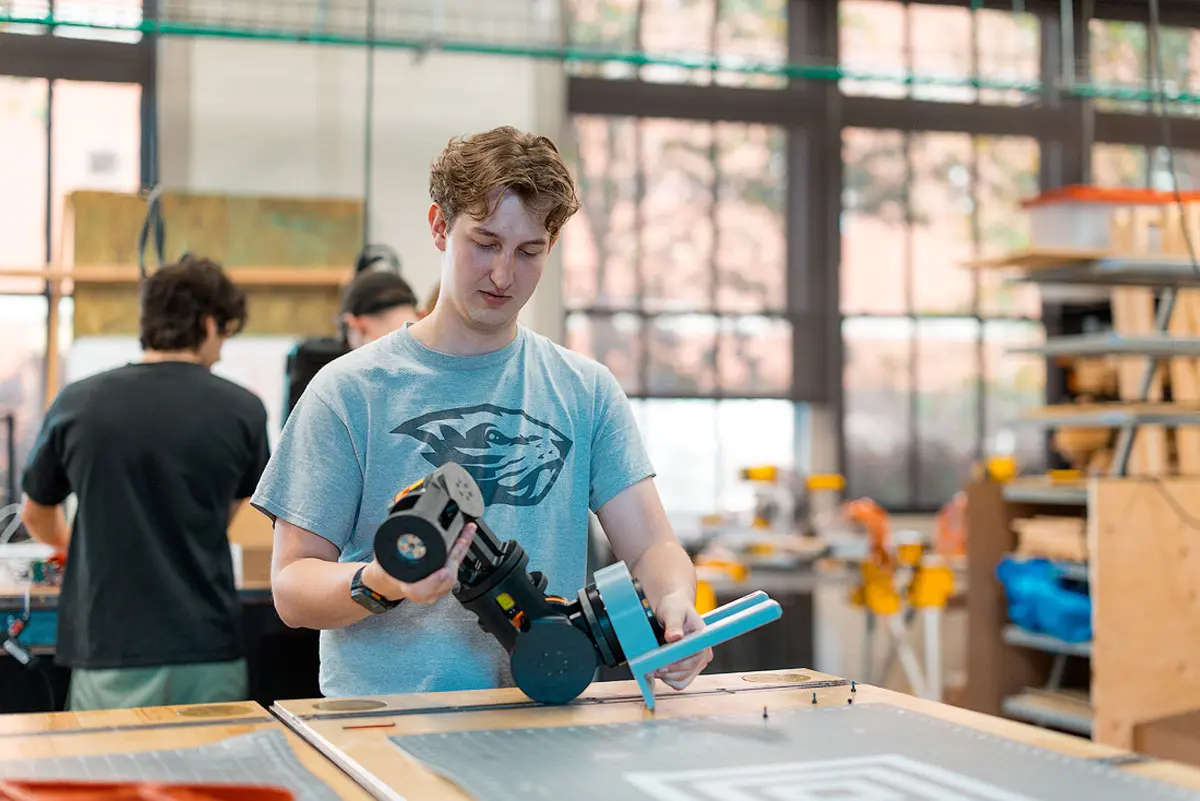
Back on campus, Roller began working with Brian Do, assistant professor of robotics. The Do Lab emphasizes hands-on experimentation, giving students opportunities to work directly with robotic systems rather than simulations alone. Roller is helping to build the next iteration of a robot with an arm that works like a self-retracting tape measure.
Working alongside faculty has helped Roller connect coursework with research-grade robotics, while still maintaining a builder’s mindset. “Having access to labs where you can actually test ideas on hardware makes a huge difference,” he said. “That’s where things stop being theoretical very quickly.”
Now, as a robotics master’s student through OSU’s Accelerated Master’s Platform, Roller also enjoys taking on projects independently. Cadfactory.ai, for example, is a tool he recently spun up that encourages rapid product development: describe the part you want in plain English, iterate quickly on the design, and export production-ready STL files in minutes. For Roller, Cadfactory offered a practical bridge between ideas and physical hardware.
“You get used to moving fast,” he said. “You’re designing, printing, testing, and fixing things almost immediately.”
robotics master's student
Blue Primary, Yellow Secondary
That same philosophy carried over into the Humanoid and Intelligent Robotics Organization, a student club Roller founded last year to give students direct access to sophisticated robotic systems. HIRO’s primary focus at the moment is building a humanoid arm, with the ultimate goal of building a complete humanoid system. For now, the club, which is sponsored by Orca Hand, RobotShop, and ODrive Robotics, is learning by experimenting with an SO-101 open-source robotic arm controlled by NVIDIA’s vision learning algorithm, Isaac Gr00t. Orca Hand recently donated a robotic hand that the club will affix to the arm.
“It’s very inspiring to me that NVIDIA’s founder and CEO Jensen Huang went to OSU and got the same degree, a B.S. in ECE, that I did,” Roller said. “I saw him speak on campus at OSU's first AI week. I’m looking forward to the Huang Collaborative Innovation Complex being completed and hope I get a chance to use the hardware.”
The team’s dozen or so members work out of the college’s Innovation Labs (iLabs) in Merryfield Hall, 3D-printing components, assembling hardware, and experimenting with AI-driven control. OSU’s Dynamic Robotics and Artificial Intelligence Lab (DRAIL) has also offered the club use of a Unitree Go2 quadruped.
“If you want to be in robotics, you need to work on an actual robot in front of you,” Roller said. “That’s really what HIRO is about.”
Engineering with an entrepreneurial mindset
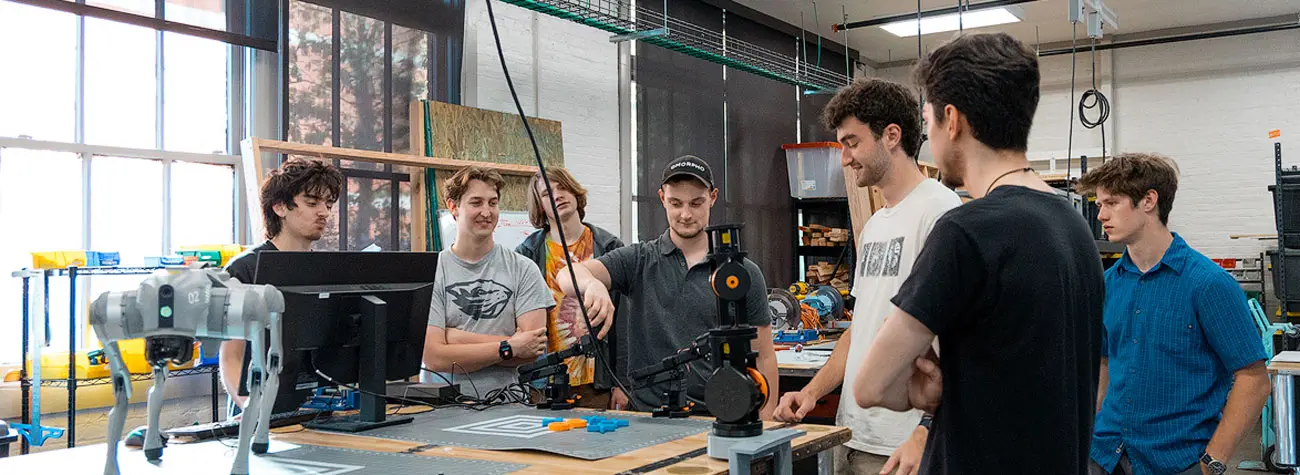
HIRO’s projects also exposed students to one of robotics’ hardest problems: actuators. The group experimented with custom cycloidal gearboxes and motor assemblies, quickly running into cost and manufacturing realities. “You learn very fast where robotics bottlenecks really are,” Roller said.
Those lessons have shaped his views on entrepreneurship. Roller is drawn to startups not for hype, but for their focus on constraints, including cost, manufacturability, and reliability. “A lot of robotics ideas fall apart when you look at the economics,” he said. “But if you can lower costs or simplify systems even a little, that’s a big deal.”
He sees OSU as an ideal place to develop an entrepreneurial mindset. Faculty support, access to machine shops, and student-led initiatives allow students to build the way startups do — by iterating quickly and learning from failure. “OSU gives you room to experiment,” Roller said. “If you’re motivated, the resources are here.”
As integration with AI helps robotics move rapidly into industry, Roller believes that blend of hands-on engineering and entrepreneurial thinking will be essential. His own path, from industrial automation to humanoid systems, shows what’s possible when students are encouraged to build early and often.
“Robotics is finally ready,” he said. “Now, it’s about making it work.”