

Decision-Making and Locomotion
Robotics Faculty Research Area
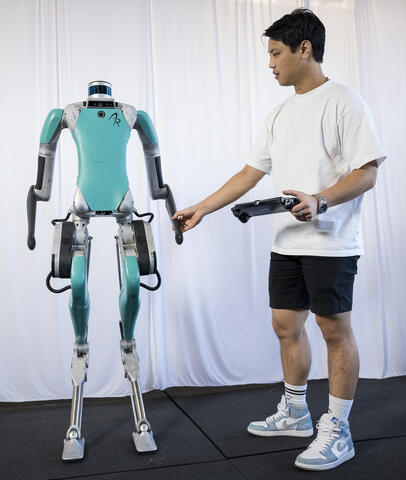
The Decision-Making and Locomotion research area focuses on the development of intelligent robotic systems that can move and act robustly in complex environments. This research spans both learning-based and model-based approaches to locomotion, including control of legged robots as well as non-traditional modes of movement such as snake-like and articulated systems. At the lower levels, work in this area studies whole-body control, motion generation, and adaptive locomotion skills that enable robots to traverse diverse and uncertain terrain.
At higher levels, the research addresses mid- and long-horizon planning for locomotion and loco-manipulation, where movement must be coordinated with task objectives, environmental constraints, and physical interactions. Central themes are understanding how to effectively combine methods from machine learning, control, and automated planning into integrated systems that support reliable, goal-directed behavior, and how to operate in multi-objective settings where mission goals or environmental conditions may change significantly during operation.
Labs
- Autonomous Systems Lab
- Human-Machine Teaming Laboratory (HMTLab)
- Intelligent Machines and Materials Lab (IMML)
- Dynamic Robotics and AI Lab
- Grimm Lab
- Laboratory for Robotics and Applied Mechanics
- Robotic Decision Making Lab (RDML)
- Visual Intelligence Research Lab (VIRL)
- Autonomous Agents and Distributed Intelligence
- Intelligent and Reliable Autonomous Systems (IRAS)
Faculty

Houssam Abbas
Associate Professor
Research Groups
Artificial Intelligence and Robotics | Cybersecurity | Communications and Signal Processing | Networking and Computer Systems | Theoretical Computer Science

Julie A. Adams
Professor | College of Engineering Dean's Professor
Additional Positions
CoRIS Associate Director for Research
Research Groups
Artificial Intelligence and Robotics | Software Engineering and Human-Computer Interaction


Alan Fern
Professor
Research Groups
Data Science and Engineering | Artificial Intelligence and Robotics
Cindy Grimm
Professor
Additional Positions
Robotics Graduate Program Director
Research Groups
Computer Graphics and Visualization | Robotics


Geoff Hollinger
Professor
geoff.hollinger@oregonstate.edu
Research Groups
Artificial Intelligence and Robotics | Robotics
Stefan Lee
Associate Professor | Brent and Elaine Leback Professor in Engineering
Research Groups
Data Science and Engineering | Artificial Intelligence and Robotics

Sandhya Saisubramanian
Assistant Professor
Research Groups
Data Science and Engineering | Artificial Intelligence and Robotics

Kagan Tumer
Professor
Additional Positions
CoRIS Institute Director
Research Groups
Artificial Intelligence and Robotics | Robotics