
Introduction
In water treatment plants across the country, operators make critical decisions every day to protect public health. They adjust chemical doses, manage flow rates, and respond to changing conditions, often relying on decades-old models to ensure water safety.
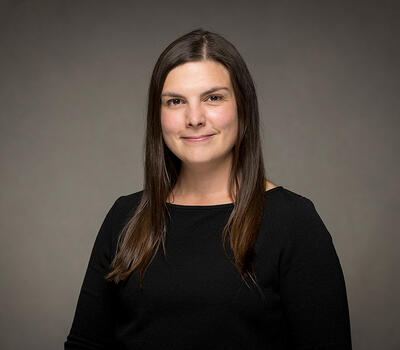
“Engineering has always depended on our understanding of physics, chemistry, and biology,” said Kathryn Newhart, assistant professor of environmental engineering. “But when all those factors come together — and you add human decision-making and environmental variability — there’s a gap between what we expect and what actually happens.”
Bridging that gap is the focus of Newhart’s work and the basis of her National Science Foundation CAREER award, one of the agency’s most prestigious honors for early-career faculty.
Her project aims to rethink how engineers model water treatment systems, using artificial intelligence to move toward a more complete understanding of how these systems perform in varying conditions.
Rethinking the model
Historically, engineers have relied on physics-based models to design and operate water systems. But they often require large safety margins to account for uncertainty — leading to higher energy use, increased chemical consumption, and inefficiencies. And water utilities are facing new challenges: emerging contaminants — such as pharmaceuticals, microplastics — aging infrastructure, energy constraints, and workforce limitations.
“Our models just aren’t cutting it anymore,” Newhart said.
With AI, there is another approach to addressing the challenges. Utilities have accumulated decades of operational data, and much of it is underused. Newhart sees that data as one of the field’s most valuable and untapped resources.
“We have rooms full of information — 6-inch-thick binders and data sitting on hard drives for years — that we haven’t fully leveraged,” she said. “Hidden in there are patterns that can help us understand how to run these systems better.”
Her work integrates that data with established scientific knowledge, combining physics-based models with AI. Rather than replacing traditional approaches, the goal is to enhance them, using machine learning to fill in the gaps where current models fall short.
The research is also designed to improve system resilience. By helping operators anticipate floods, equipment failures, and other unexpected events, AI can provide real-time insights that support proactive decisions and more reliable operations.
assistant professor of environmental engineering
Blue Primary, Yellow Secondary
Newhart’s research is set apart by its scale. Most data-driven models in water treatment are built using information from a single facility. As a result, they often don’t translate well to other locations, where conditions differ. Newhart’s project draws on data from 35 water and wastewater treatment facilities across the country, allowing her to build models that reflect a broader range of real-world conditions.
“Just because a model fits one system doesn’t mean it represents what’s actually happening,” she said. “By looking across many systems, we can start to distinguish what’s real from what’s just an artifact of that specific dataset.”
This approach aims to produce models that are not only more accurate, but more adaptable and able to support decision-making across different systems.
Designing for the real world
While the technical challenges are significant, Newhart is focused on a very practical audience: the operators who manage treatment plants every day.
“They’re the decision makers,” she said. “They’re the ones responsible if something goes wrong.”
That responsibility often leads operators to take a conservative approach, using more chemicals or energy than might be necessary, to reduce risk. AI could help change that. By synthesizing large volumes of data and providing clearer insights, these tools can support more precise, confident decisions in real time. But for that to happen, trust in the model is essential.
“It’s not just about accuracy,” Newhart said. “It’s about how the model behaves when something unexpected happens — when a sensor fails, or conditions change. Operators need to know they can rely on it.”
Expanding access
The benefits of this approach could be especially significant for smaller communities.
Traditional data-driven models require large datasets, putting advanced tools out of reach for many utilities with limited monitoring capacity. By developing models that draw on data from multiple systems, Newhart aims to reduce that barrier, enabling smaller facilities to use tools built on shared knowledge.
“They don’t have to start from scratch,” Newhart said. “They can use models that already capture how these systems behave more broadly.”
The project also explores new ways to share models while protecting sensitive data. Using techniques like federated learning, a way to train AI without moving sensitive data to a central database, utilities can contribute to and benefit from larger models without centralizing and exposing their raw data, addressing a key concern in the sector.
Training the next generation
A defining feature of the CAREER award is its emphasis on education. Newhart is developing modules that integrate data science and AI throughout the environmental engineering curriculum, rather than isolating those skills in a single course.
“Right now, students often learn statistics separately from their engineering work,” she said. “But real-world data doesn’t follow the assumptions you learn in a basic stats class.”
Her approach embeds data-driven thinking across multiple levels, helping students build both literacy and depth of understanding over time.
The project also includes outreach to K–12 classrooms through partnerships with Oregon State University’s precollege Science & Math Investigative Learning Experiences program, introducing younger students to data, systems, and water quality concepts.
Looking ahead
As water systems face increasing pressure from resource constraints, Newhart sees a growing need for models that reflect the complexity of real-world operations.
“We’re trying to better understand how these systems actually work,” she said. “And once we understand that we can make better decisions.”
Ultimately, these decisions will have far-reaching implications — improving access to the foundation of life: clean water.