
Introduction
On a warm morning in June, a handful of Oregon State University’s Radiation Center facility managers and scientists gently lifted a hulking, 10x20x12-foot- metal framework off a massive flatbed truck, set it on rollers and a temporary platform, slid it slowly through the door on the east side of the center with roughly one inch of clearance on each side, and then sandwiched it into its final resting place.
The whole process took about 6 hours. But for the team at the Oregon State University Radiation Center, installing the equipment in question was a feat of precision four years in the making. While it sounds like a massive undertaking, the whole ordeal was business as usual: The arrival of the nuclear research facility, a thermal-hydraulic test loop called SoFIE designed for Bellevue, Washington-based TerraPower, marks the latest entry in the center’s long tradition of making the most out of every square foot.
Musical chairs, but for nuclear facilities
Inside the Radiation Center, space is at a premium. All experiments requiring nuclear power or materials must take place here, under strict safety and security protocols. Every addition — like SoFIE, which stands for Sodium Flow Investigation Experiment — requires a sequence of moving, reconfiguring, and often decommissioning older setups to make room for the future. Last summer, a forklift eased a smaller facility, called BILL, out from between two of its neighbors, one move in a larger chain of relocations and reconfigurations that ultimately helped create room for future additions such as SoFIE. It’s a painstaking process that faculty liken to the game “musical chairs.”
director of the Radiation Center
Blue Primary, Yellow Secondary
Rather than limiting innovation, the center’s compact footprint has created a culture of collaboration and resourcefulness. Faculty and students work side by side, sharing space and ideas and delivering excellent research and unique solutions to their industry partners. And while getting SoFIE into its new home was a challenge, the achievement demonstrates what’s possible when a bold vision outpaces limitations.
High bay ops 101
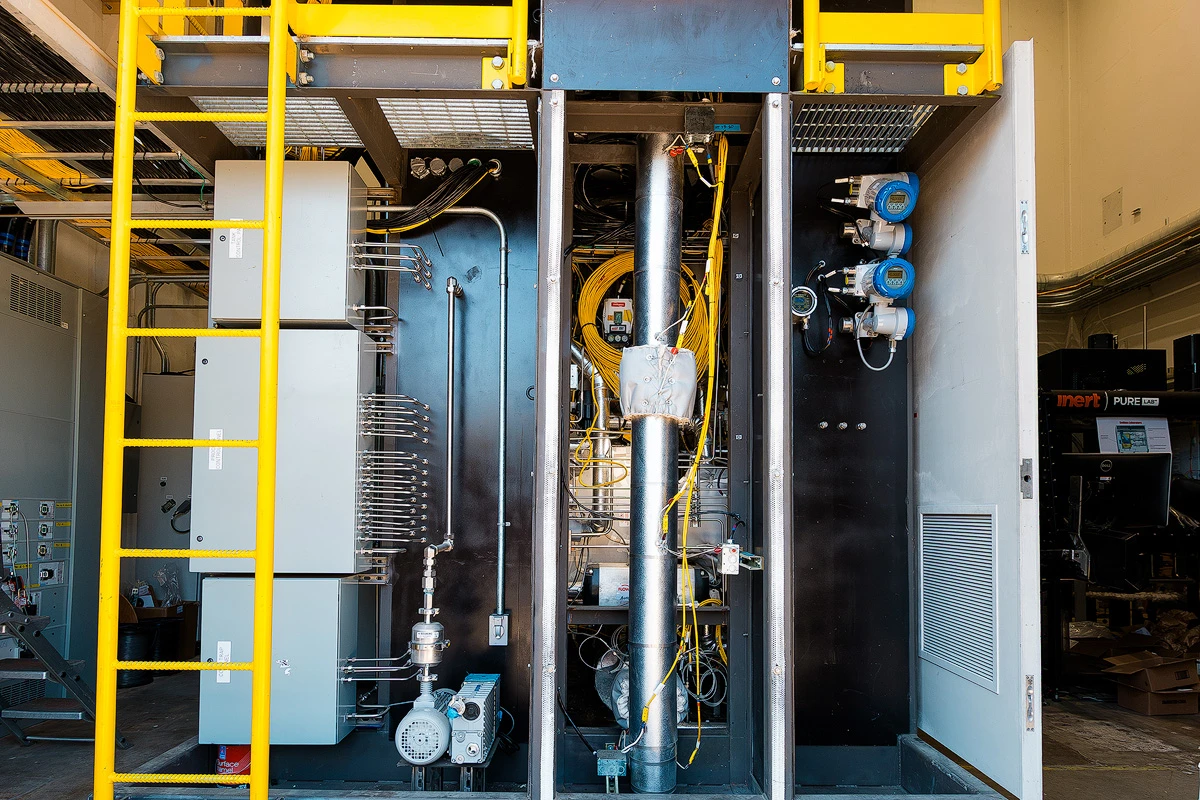
Step inside the Radiation Center’s three high bays and you’ll find a world of blue and yellow metal ladders and railings wrapped around hulking metal towers. Totaling about 4,000 square feet, the three cavernous spaces are host to nine distinct research facilities, each packed with steel structures enclosing specialized equipment that stretch nearly to the center’s 35-foot ceilings.
One high bay is dominated by the Advanced Nuclear Systems Engineering Laboratory, which is home to two major thermal-hydraulic test facilities. Another high bay, the Advanced Thermal Hydraulics Research Laboratory, investigates the fundamental properties of multiphase fluid flow and heat transfer and houses the Multi-Application Small Light Water Reactor.
SoFIE joins a few other projects in the Sodium Laboratory, which is a dedicated sodium high bay, a rarity in the university nuclear research world partly due to strict safety requirements. Sodium handling is hazardous and highly specialized, requiring an oxygen- and water-free environment. SoFIE is an industry-scale experimental test loop for studying heat transfer and fluid flow around an electrical heater-based simulation of the nuclear fuel rods of TerraPower’s Natrium® reactor, an advanced nuclear reactor built with TerraPower and GE-Hitachi technology and using liquid sodium as a coolant. When the first Natrium reactor is fired up, possibly as early as 2030 in Wyoming, it will enable cheap, safe, and efficient nuclear power production.
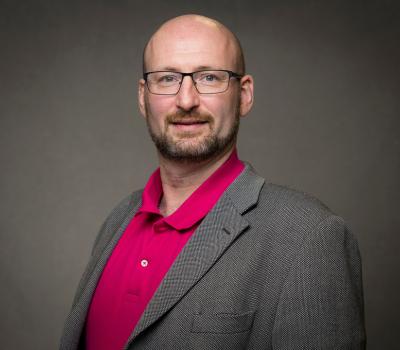
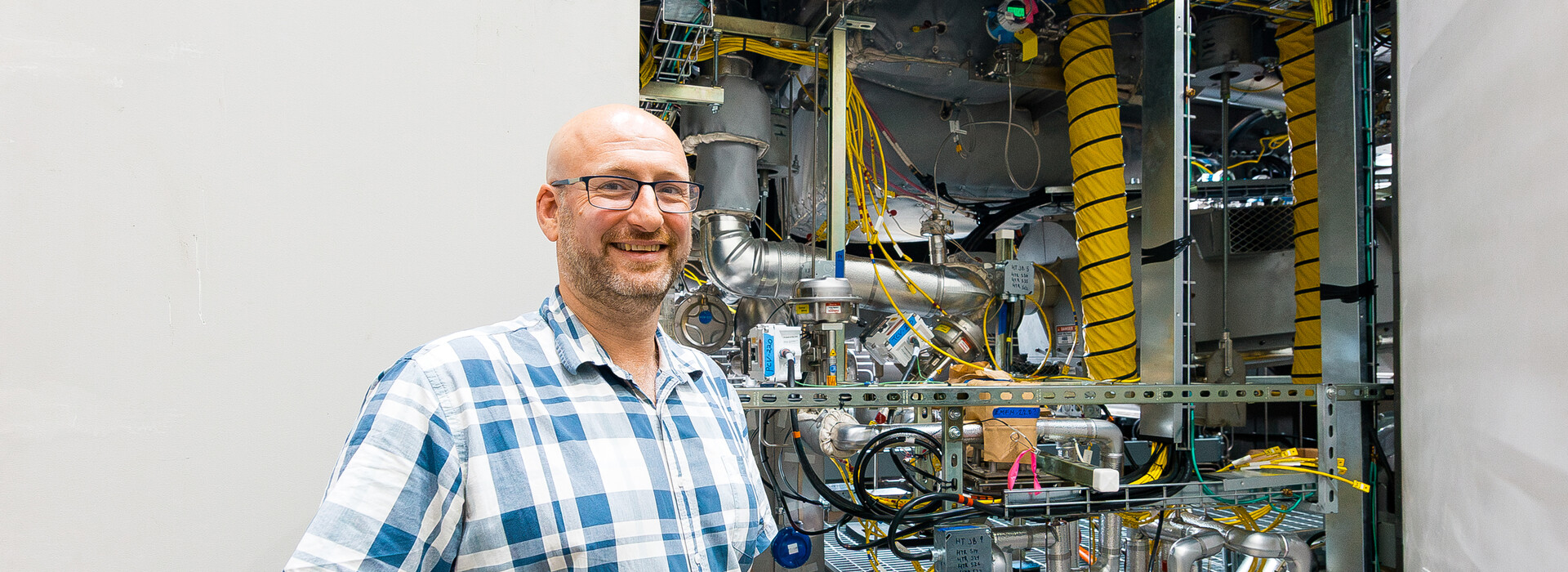
Associate Professor of Senior Research Guillaume Mignot says that what brings life to a new facility is often the end of an old one. In the case of the sodium high bay, it was the decommissioning of the APEX facility used to test the Westinghouse AP1000 reactor design. The facility had outlived its usefulness because the design was a success — the reactors are now being built, and no further testing is needed.
Since APEX was a one-trick pony of sorts, it was scrapped for parts, and after some shuffling, the high bay it occupied was ready to be transformed into a sodium-only space for new projects. It took little time for industry to come calling.
“Even companies that do their own testing have limited space,” Mignot said. “So, when you say, ‘Hey, I have space dedicated for your technology to be tested,’ they come to us.”
Oregon State University’s senior vice provost for academic affairs and the Henry W. and Janice J. Schuette Professor in Nuclear Science and Engineering
Blue Primary, Yellow Secondary
What it takes to bring a new facility online
Considerations for a new facility extend beyond square footage. Compressed air, water, and safety protocols for new materials are all factors to consider when deciding what to add to a high bay and how long the runway needs to be to prepare for it. The biggest consideration, though, might be electricity.
Because of the electrical load required for nuclear experiments in the high bays, each facility must install separate, unique transformers with the local power utility. One particular high-bay facility that requires a specific, very high temperature for its testing draws 2.5 megawatts of power per experiment. That is roughly enough electricity to power 2,000 U.S. homes.
But the impact of such tests is worth the energy expenditure. That will especially be the case with SoFIE, with the fuel bundle simulator accounting for more than 1.1 MW alone.
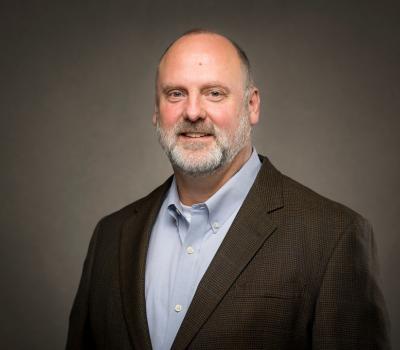
“OSU's work contributes toward conducting experimental research that will produce license-quality data demonstrating the safety case for the natrium reactor,” said principal investigator on the SoFIE project, Wade Marcum, Oregon State University’s senior vice provost for academic affairs and the Henry W. and Janice J. Schuette Professor in Nuclear Science and Engineering.
Partner of choice
When companies in the nuclear engineering industry look for partnerships, Oregon State is an easy choice. As it has for decades, the Radiation Center maintains NQA-1 standards—the highest set of quality assurance requirements in the industry. Oregon State is the only university to hold such a distinction, making it a partner of choice for industry leaders like TerraPower, which has sought Oregon State’s expertise for its most ambitious projects over the past 12 years.
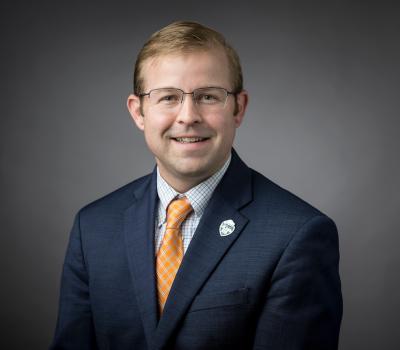
As Steven Reese, the director of the Radiation Center, noted, “We have the pedigree.”
NQA-1 is the reason Oregon State is the only university to have participated in the testing of new reactor designs approved by the U.S. Nuclear Regulatory Commission (NRC). The first was the AP1000, licensed by the NRC in 2006. In 2023, the NuScale small modular reactor became the second. It made history as the first small modular reactor design to be licensed in the U.S.
“When you think about what draws faculty and students to OSU nuclear engineering, it’s that capability,” Reese said.
That capability is also why Oregon State was confident about building a sodium high bay in the first place. The Radiation Center team trained and performed drills and demonstrations with the Corvallis Fire Department for two years to prepare to use the space. It has also adopted rigorous safety protocols to keep the hazardous material to be used in the bay under close control.
What’s next
So, what’s next for the Radiation Center? More space could be on the horizon. Why does more space matter? Because faculty ideas are never in short supply. “You know what they say about nature abhorring a vacuum,” Reese said. “The folks here have enough ideas in the back of their brains that, as soon as space is available, they’ve got ideas on how to use it.”
With continued support from donors and partners, the Oregon State University Radiation Center will keep pushing the boundaries of nuclear science, proving that excellence isn’t about size, but about vision, ingenuity, and impact.