

Introduction
When Oregon State University’s powerful new NVIDIA supercomputer comes online in the Jen-Hsun Huang and Lori Mills Huang Collaborative Innovation Complex, it won’t simply make existing research run faster. It will help researchers tackle scientific problems currently beyond reach, ultimately boosting semiconductor manufacturing in Oregon and supporting economic prosperity and opportunities for Oregonians.
For Kyle Hale, associate professor of computer science, that means helping scientists translate cutting-edge research into software that can fully exploit high-performance computing resources. Hale specializes in the systems software that underpins high-performance computing, and one of his first major collaborations since arriving at Oregon State in 2024 shows how the university’s expertise can amplify research across the region.
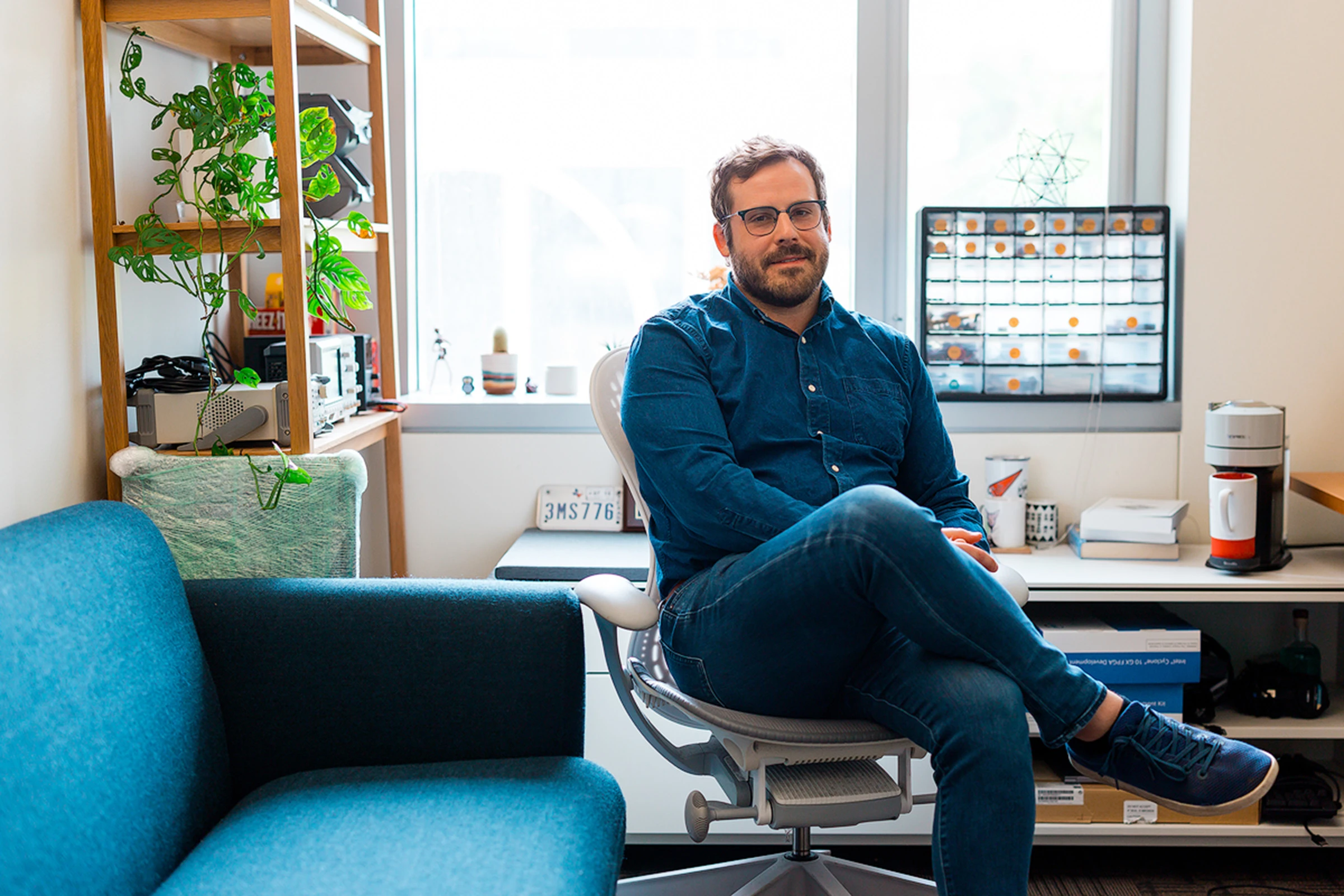
Working with University of Oregon physicist Kayla Nguyen, computer scientists Thanh Nguyen and Allen Malony, and collaborators from Intel, Hale is preparing to port sophisticated image reconstruction algorithms, developed by the UO team, to OSU’s advanced computing infrastructure, allowing researchers to analyze vastly larger datasets than they can today. The effort highlights Oregon State's growing role as a regional hub for high-performance computing and serves as an early example of the collaborative research envisioned through the National Science Foundation’s FAST Regional Innovation Engine, which aims to accelerate semiconductor research and workforce development.
FAST co-director of research and professor of electrical and computer engineering
Blue Primary, Yellow Secondary
"My role is to facilitate the use of OSU's high-performance computing resources and help guide the use of high-performance computing techniques to accelerate their codes," Hale said. While the collaboration is still in its early stages, he expects the Huang Complex to help bring together the computing expertise, domain knowledge, and industry partnerships needed as the project scales.
Solving an “inverse problem” at the atomic scale
Nguyen's research addresses one of the semiconductor industry's most difficult imaging challenges: understanding the three-dimensional structure of materials at the scale of individual atoms.
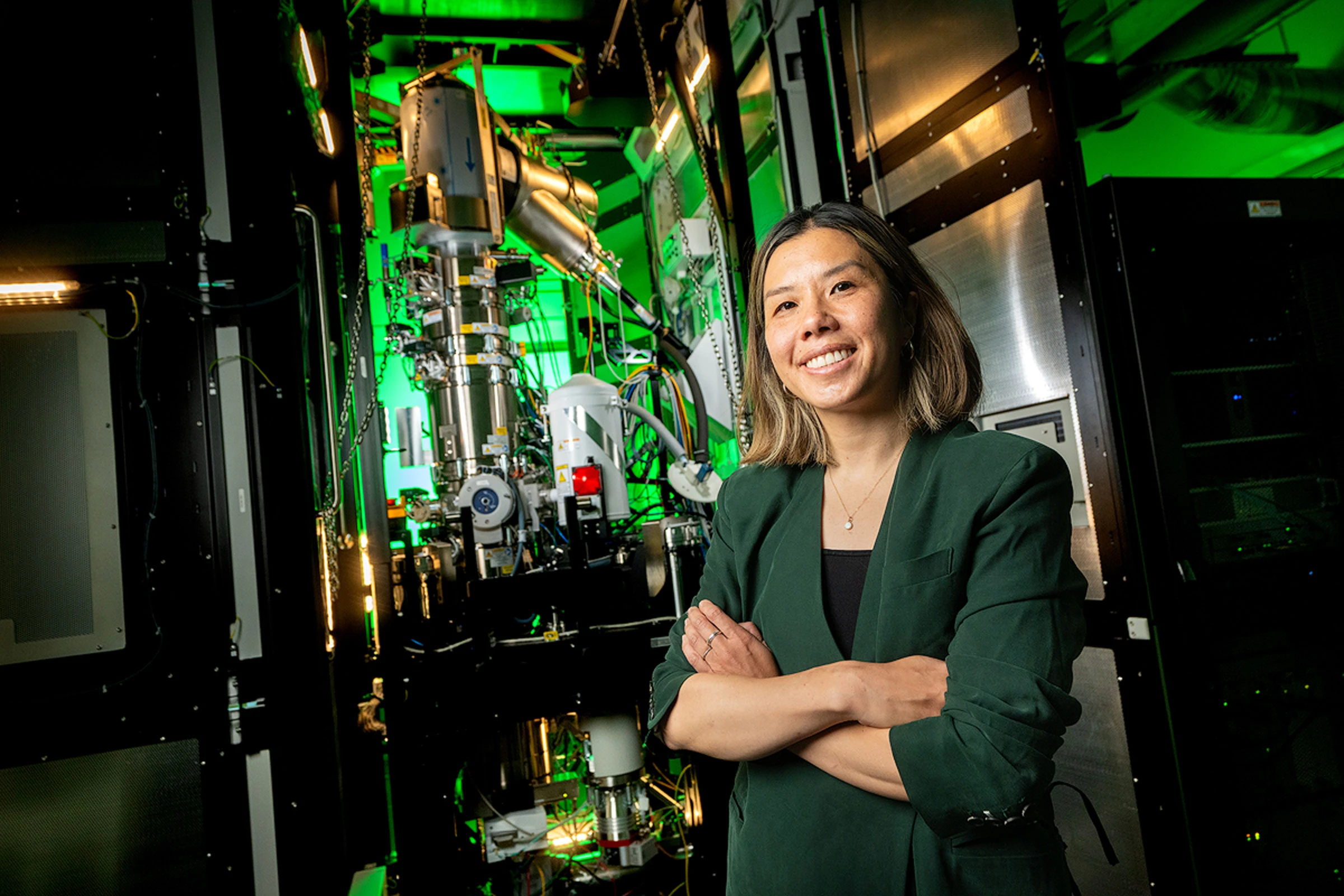
Using an advanced electron microscope, purchased in 2025 with a $2.7 million grant from the National Science Foundation, researchers collect diffraction patterns — complex measurements that contain information about a material's structure. But converting those two-dimensional patterns into accurate three-dimensional images requires solving what physicists call an inverse problem, an extraordinarily computationally intensive process.
Nguyen’s lab specializes in ptychography, an advanced computational imaging technique that reconstructs three-dimensional atomic structures by scanning an electron beam across a sample and analyzing thousands of overlapping diffraction patterns. The approach offers capabilities unavailable through conventional microscopy, particularly for semiconductor devices built on thin films that cannot simply be rotated to collect images from every angle.
What Intel wants — and why it reached out
Nguyen's expertise attracted Intel after she presented her research during a workshop connecting Oregon universities with company scientists. Intel recognized that her work sits at the intersection of physics and computer science, combining advanced microscopy with sophisticated computational methods.
Today, the collaboration has two closely connected goals.
The first is helping Intel visualize the three-dimensional structure of next-generation semiconductor materials. The second is developing a physics-informed artificial intelligence software package that can dramatically accelerate the reconstruction process. Rather than relying solely on conventional machine learning, K. Nguyen, T. Nguyen, and collaborators are combining AI with the underlying physics governing electron diffraction to improve both speed and accuracy while avoiding the errors that can arise from purely data-driven approaches.
Ultimately, Intel plans to use the software to transform diffraction data gathered in-house into interactive three-dimensional visualizations that can support the company’s semiconductor research and manufacturing.
Scaling up with Oregon State's HPC resources
As the team’s AI models mature, however, the project's computational demands will quickly exceed the capabilities of individual laboratory workstations.
Training the models requires enormous datasets, and larger datasets translate directly into more accurate reconstructions. That's where Hale, Malony, and Oregon State's high-performance computing expertise become essential.
"The data sets that we get are quite large," Nguyen said. "If we want higher precision and higher accuracy, we need to handle larger data. Kyle and the new NVIDIA supercomputer can help us handle really large data so that we can improve accuracy and precision in our model."
associate professor of computer science
Blue Primary, Yellow Secondary
Hale's contribution will extend beyond simply providing access to computational horsepower. Since joining Oregon State's growing high-performance computing group — known informally as HiPCastor — in 2024, after seven years on the faculty at Illinois Institute of Technology, he's focused on system software that makes HPC codes run more efficiently. That includes developing new approaches to disaggregated memory that let programs borrow unused memory from other machines across a network, enabling researchers to use many interconnected processors and graphics processing units simultaneously.
As the collaboration progresses, he expects to help port the image reconstruction software to Oregon State's computing environment, ensuring it can scale effectively on the NVIDIA-based system planned for the Huang Collaborative Innovation Complex.
Hale sees it as a proof of concept for something he and Oregon State's broader HPC group hope the Huang Complex will enable more widely: bringing together researchers with deep domain expertise and the computational resources needed to tackle problems that would otherwise remain out of reach.
"We’re very interested in democratizing access to OSU’s high-performance computing resources, including the Huang Complex supercomputer," Hale said.
A proof point for Oregon's FAST engine
The collaboration also illustrates the type of cross-institutional partnership the NSF FAST Regional Innovation Engine was designed to encourage.
Although Nguyen's Intel project predates the FAST award, it came about from the industry-university interactions that NSF’s planning grant to FAST facilitated. The initiative brings together complementary strengths from across Oregon: University of Oregon researchers contribute expertise in electron microscopy, computational physics, and AI; Oregon State provides advanced high-performance computing capabilities; and Intel supplies industry perspective and real-world semiconductor challenges. Nguyen believes FAST funding can further strengthen those connections and accelerate the project's progress.
“This project is a shining example of what the FAST Engine will deliver,” said Pallavi Dhagat, FAST co-director of research and professor of electrical and computer engineering at Oregon State University. “It will catalyze connections, enable access to the shared resources in the ecosystem, and accelerate research so that Oregon's continued leadership in semiconductor manufacturing supports economic prosperity and opportunities for Oregonians.”
For Oregon State, the collaboration demonstrates that the Huang Complex will be more than a home for powerful hardware. It will provide the expertise needed to help researchers harness that hardware to solve problems that matter, from advancing semiconductor manufacturing to building new partnerships that strengthen Oregon's innovation ecosystem.