


What Engineering is Best for a Career in Robotics?
Robots can explore the ocean, work alongside people in warehouses, harvest crops, assist patients, and even investigate the surfaces of other planets. But who actually creates them? The answer might not be what you expect.
How engineering powers robotics
Creating a robot requires expertise in mechanics, electronics, computing, artificial intelligence, controls, and systems design. That means there are several engineering degrees that can prepare you for a career in robotics.
The point is this: Robotics brings multiple engineering disciplines together. You get to pick which one suits you best.
At Oregon State University, students interested in robotics approach the field from several directions, depending on which part of the technology excites them most.
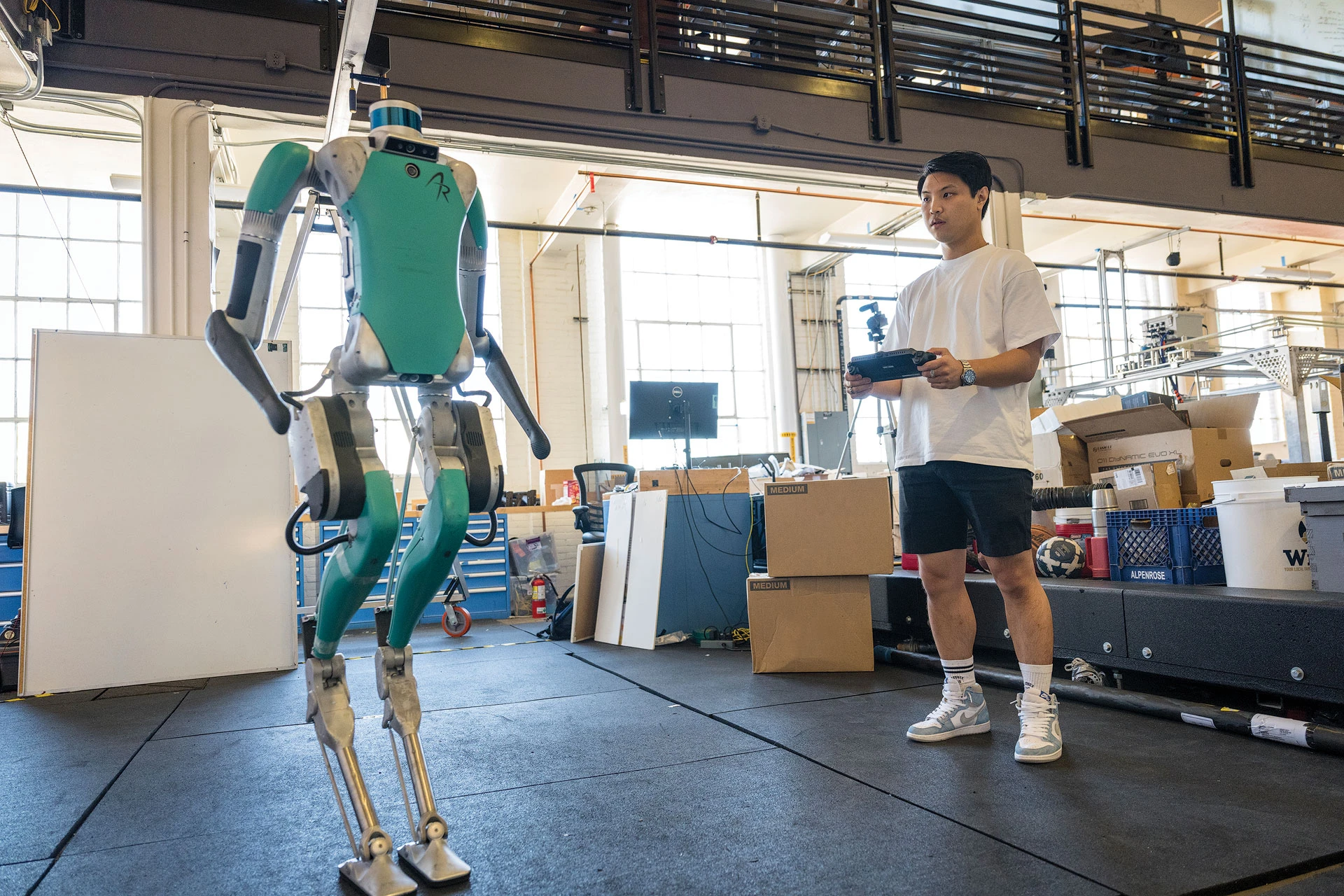
Think about a robot like Digit, the humanoid robot whose technology originated from research at Oregon State. Building Digit requires mechanical systems that allow it to walk and move, electrical components and sensors that help it understand its surroundings, software that controls its behavior, and systems that enable it to work effectively alongside people. So, if you want to work in robotics, the better question might be:
What part of a robot do you want to work on?
Your answer can help point you toward the engineering major that's right for you.
Learn more: What is Robotics Engineering?
Mechanical engineering
Best for students who want to design, build, and understand how robots move.
If you're fascinated by the physical side of robots, how they walk, grasp objects, withstand forces, or interact with their environments, mechanical engineering may be a great fit.
Mechanical engineers can design the structures, joints, mechanisms, and other components that allow robots to move and perform tasks. Oregon State mechanical robotics research spans areas including locomotion, manipulation and grasping, soft robotics, field robotics, and bio-inspired robotics.
For students, that can mean opportunities to apply mechanical engineering to problems far beyond a traditional factory robot. For example, Oregon State mechanical engineering student Lara Rupnawar worked in Dr. Naomi Fitter’s lab studying human-robot interactions. Lara helped build and program SAMI, a small robot who can help keep people engaged during physical therapy and assist in nursing homes.
Robotics careers for mechanical engineers
- Robotics Engineer
- Mechanical Design Engineer
- Mechatronics Engineer
- Robotics Hardware Engineer
- Product Development Engineer
- Automation Engineer
Explore Mechanical Engineering
Electrical and computer engineering
Best for students interested in the electronics, sensors, power, and controls that make robots work.
A robot needs more than a body. It also needs a way to sense what's happening around it and respond.
Electrical and computer engineers work with the electronics behind robotic systems, including circuits, sensors, embedded computing, and controls. Electrical and computer engineering is the field responsible for components such as a robot's power systems, cameras, sensors, and spatial awareness.
Those skills connect directly with Oregon State research in intelligent and autonomous systems. Researchers study areas including perception and interpretation of sensor data, automated decision-making and control, and robotics operating at different levels of autonomy.
At a 10-week internship with Medtronic, ECE student Lesly Rojas worked to strengthen software communication protocols in the Hugo Robotic-Assisted Surgery System, an open surgical console with an HD-3D display, a system tower, and four robotic arms. Lesly focused on minimizing data loss between components of the system by ensuring a communications simulator stores data properly.
Robotics careers for electrical and computer engineers
- Robotics Engineer
- Controls Engineer
- Embedded Systems Engineer
- Electrical Engineer
- Electronics Engineer
- Automation Engineer
Explore Electrical and Computer Engineering
Computer science and artificial intelligence
Best for students who want to program how robots perceive, learn, decide, and act.
If the mechanical components are the robot's body, software helps provide its intelligence.
Computer scientists develop the algorithms and software that allow robots to navigate, recognize objects, interpret information, make decisions, and learn. Oregon State's artificial intelligence and robotics research includes machine learning, computer vision, automated planning and reasoning, perception, and decision-making.
Oregon State computer science student Madelyn Sadler worked for two years on a project sponsored by the Office of Naval Research to develop an innovative human interface that helps interpret feedback from sensors attached to underwater robots.
Computer science may be an especially good path if you're excited by questions such as: How does a robot know where it is? How does it decide what to do next? How can it recognize something it has never seen before?
Robotics careers for computer scientists
- Robotics Software Engineer
- Artificial Intelligence Engineer
- Machine Learning Engineer
- Computer Vision Engineer
- Autonomous Systems Engineer
- Robotics Engineer
Industrial engineering
Best for students interested in how robots, people, and complex systems work together.
Robotics isn't only about designing the robot itself. Someone also has to determine how robots can be used effectively in the real world, and that's where industrial engineering comes in.
Industrial engineers examine entire systems, including the interaction between technology and the environment. For robotics, that can mean figuring out how robots fit into manufacturing facilities, warehouses, healthcare settings, and other workplaces with people and uncertain elements.
Oregon State faculty have been working on equipping dog-like robots with the tools and programming needed to explore uncertain terrain while performing scientific tasks like experiments and data collection on the surface of the moon and Mars. Undergraduate industrial engineering student Mason Allen was part of the team conducting field tests on Mount Hood, Oregon, a landscape that simulated that of the moon.

Robotics careers for industrial engineers
- Automation Engineer
- Robotics Systems Engineer
- Manufacturing Engineer
- Systems Engineer
- Process Engineer
- Human Factors Engineer
Explore Industrial Engineering
What about a robotics engineering degree?
Here's an important distinction for prospective college students: robotics itself is not always a standalone undergraduate degree. That means you don't have to hunt for a bachelor's degree called "robotics" or “robotics engineering” to start preparing for your robotics career.
Instead, build expertise through a discipline such as mechanical engineering, electrical and computer engineering, computer science, or industrial engineering while gaining experience with robotics. That multidisciplinary approach reflects what robotics is actually like, and ensures you have enough depth of knowledge and skills in one field to be a strong contributor.
Oregon State's robotics program brings together work in areas as varied as underwater robotics, human-robot interaction, agricultural robotics, drones, soft robotics, bio-inspired robotics, and robots for education and healthcare.
Oregon State’s robotics student organizations also bring all the fields together. For example, the Oregon State Mars Rover Team designs, develops and implements every component of a small-scale Mars rover: custom PCBs, a six-axis arm, autonomous navigation, and more. The team has repeatedly placed first in the Canadian International Rover Challenge, one of the biggest collegiate competitions of its kind.
Putting it all together
So, the best engineering degree for a career in robotics depends on what you'd most like to create.
- If you want to design how robots move: Consider mechanical engineering.
- If you want to build their electronics, sensors, and controls: Consider electrical and computer engineering.
- If you want to develop their software and intelligence: Consider computer science or artificial intelligence.
- If you want to determine how robots work alongside people and within larger systems: Consider industrial engineering.
Robotics is inherently collaborative, and whatever path you take, you'll be developing skills that can contribute to robots working in places ranging from farms and factories to hospitals, oceans, and beyond.