

Introduction
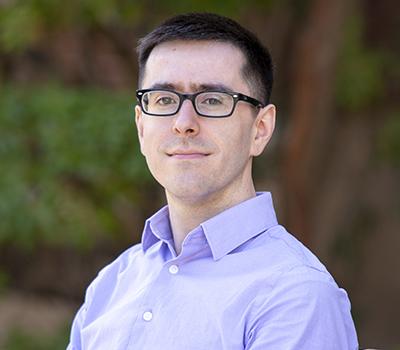
By day, Akhil Perincherry develops perception systems for Ford that end up in the company’s trucks, including the popular F-150. By night, he’s a Ph.D. candidate in Artificial Intelligence at Oregon State University’s Dynamic Robotics and Artificial Intelligence Laboratory (DRAIL), where he teaches robots to navigate the world efficiently and effectively.
Trucks and robots might seem quite different, but for Perincherry, they’re both aligned with his academic interest: embodied AI. “I’m broadly interested in agents that can ground language in perception, reason about their environment, and take actions accordingly,” Perincherry said.
From trailers to robots
Perincherry's academic journey began at the Indian Institute of Science and continued through a M.S. degree earned at the University of Florida in 2016. He came to his studies with an interest in computer vision and sensing but, as he gained experience, his interests broadened to include embodied AI systems that adapt, respond, and take actions based on what they perceive.
AI Ph.D. student
Blue Primary, Yellow Secondary
“If you think about practical deployments, static sensing only gets you so far,” Perincherry said. “Real environments are often dynamic and interactive. An embodiment, whether a vehicle or a legged platform, has to not only understand the world but operate in it.”
After earning his M.S., Perincherry moved to Dearborn, Michigan, to work for Ford, where he’s currently a senior perception engineer. Perincherry has contributed to various autonomous and semi-autonomous driving features, including a semi-autonomous trailering technology for Ford's trucks.
Backing up a trailer is counterintuitive. “When you steer left while reversing, the trailer actually swings right, which is opposite of what you would expect," Perincherry explained. Ford's Pro Trailer Backup Assist uses cameras and sensors to automatically steer the truck when reversing with a trailer attached. The driver simply turns a knob on the dashboard to guide the trailer.
Using OSU’s resources to create more efficient embodied AI
When Perincherry decided to pursue a Ph.D. to explore embodied AI more deeply, Oregon State seemed an obvious fit. A fan of outdoor sports and hiking, he’d fallen in love with Oregon’s natural beauty and amenities on a previous trip and happily moved to Corvallis.
More importantly, Stefan Lee, associate professor of electrical and computer engineering, DRAIL co-director, and holder of the Brent and Elaine Leback Endowed Engineering Professorship, impressed him as someone "heavily invested in his students’ success, not just at a professional level, but also at a human level."
OSU’s Collaborative Robotics and Intelligent Systems (CoRIS) Institute, where DRAIL is just one of more than 30 robotics labs, offers access to a wide range of robots, including the Unitree Go2, a quadrupedal robot about the size of a Corgi. These resources have given Perincherry the chance to explore a fundamental challenge in robotics: energy efficiency.
"A robot that is charging is not doing useful work," Perincherry said. He points out that robots may operate only a few hours on a charge, and sometimes last less than an hour, which can hamper their deployment.
He is a co-author on a recent paper, alongside Lee and two other OSU Ph.D. students, which was published at the Conference on Robot Learning in 2025 and accepted for an oral presentation. The results were significant: a 64% reduction in energy expenditure to perform a task, such as walking or standing, without a sacrifice in performance.
In addition to access to OSU’s robots, Perincherry says his research was aided by access to high-performance computing resources supported by staff such as Robert Yelle, OSU’s manager of High Performance Computing. These compute resources helped Perincherry and his co-authors train the more energy-efficient model presented in the paper.
A future in embodied AI
Looking ahead, Perincherry aims for a technical leadership role that bridges academic research with product impact.
"In academia, we get to work on the real state-of-the-art solutions, at the forefront of technology," Perincherry said. "But in industry, we have more access to scale and compute, and are also able to connect these solutions to things that customers truly want. Being able to leverage academia's research and translate it into societal impact is something that appeals to me."
While his time at Ford has provided experience navigating this intersection, the research he's doing as part of his doctorate at OSU can reinforce that strength with new insights and resources. After all, as he sees it, autonomous vehicles and robots are practically siblings. They’re both embodied AI.