

Introduction
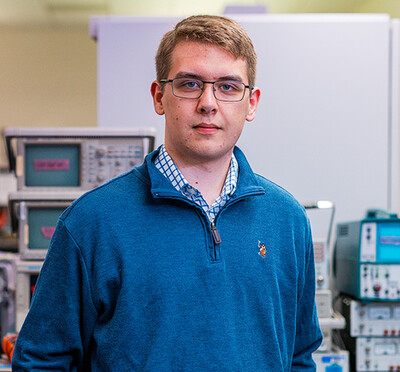
“Multi-generational” is not a term often ascribed to research, but in the field of nuclear waste storage, it’s a necessary consideration. This centuries-old logistical and environmental challenge fascinates Maxwell Kavanagh, a doctoral student in nuclear engineering whose research focuses on the interim storage of spent nuclear fuel.
“I want to have a lasting impact and make people’s lives better,” Kavanagh said. “And that’s easier with an applied approach to something that will be used in the real world.”
Kavanagh is developing a method to monitor the internal environment of dry storage casks, or giant canisters of spent nuclear fuel, from the outside. By measuring thermal and radiation signatures, a high-resolution detector could be a reliable way to identify damage to the casks, like broken fuel rods or leaking helium.
nuclear engineering graduate student
Blue Primary, Yellow Secondary
But obtaining access to real dry storage casks for study is difficult, so Kavanagh is using Monte Carlo N-Particle (MCNP) computer modeling programs and multiphysics simulation software such as Simcenter Star-CCM+ to simulate how different accidents and their subsequent fission products are detected.
An unmet need in the nuclear industry
Many dry storage casks, originally licensed for 40 years, will now be used for up to 100 years or more due to the indefinite suspension of the Yucca Mountain nuclear waste repository. This makes Kavanagh’s research even more significant. “It’s important to do these kinds of analyses so we can ensure our systems are safe and functioning properly,” he said.
This sentiment is shared by the U.S. government. In August, Kavanagh was awarded the Nuclear University Energy Program fellowship, a three-year, $175,000 fellowship funded by the Department of Energy to pursue research in nuclear energy. He will also receive funding for an internship at a national lab.
The fellowship will fund the final year of Kavanagh’s master’s degree and springboard his doctoral interests. He intends to continue research on dry storage casks, but has the freedom to change focus so long as it relates to nuclear energy, he said.
“It’s an exciting time to be a student or young professional in nuclear energy,” Kavanagh said.
Finding support in Oregon State’s nuclear engineering program
Kavanagh’s interest in nuclear engineering began at Oregon State University as an undergraduate, where he learned that the field combined his interests in fundamental science and applied research.
For his senior capstone project, Kavanagh simulated a loss-of-coolant accident at Oregon State’s TRIGA Reactor, specifically measuring the effects of skyshine, or the radiation that scatters back to earth.
Feeling supported in this project, and by the School of Nuclear Science and Engineering as a whole, Kavanagh continued graduate study under the advisement of Haori Yang, associate professor of nuclear science and engineering.
“We have a lot of great professors in our program,” Kavanagh said. “Everyone is passionate about what they are doing and making a big difference in the nuclear field.”
Through connections with another NEUP program, Kavanagh interned at the Pacific Northwest National Laboratory this past summer, in a collaboration with Oregon State and the University of Utah. During this internship, Kavanagh simulated abnormal events, like earthquakes or heavy snow accumulation, and analyzed their effects on dry storage casks using computer modeling.
After this experience, Kavanagh feels drawn to working for a national lab. “I’m interested in national labs’ mix of valuable research and its implementation by different industries and governments,” he said.