

Introduction
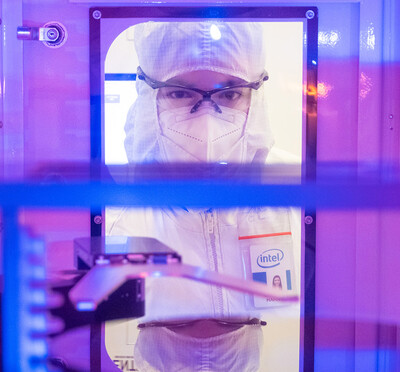
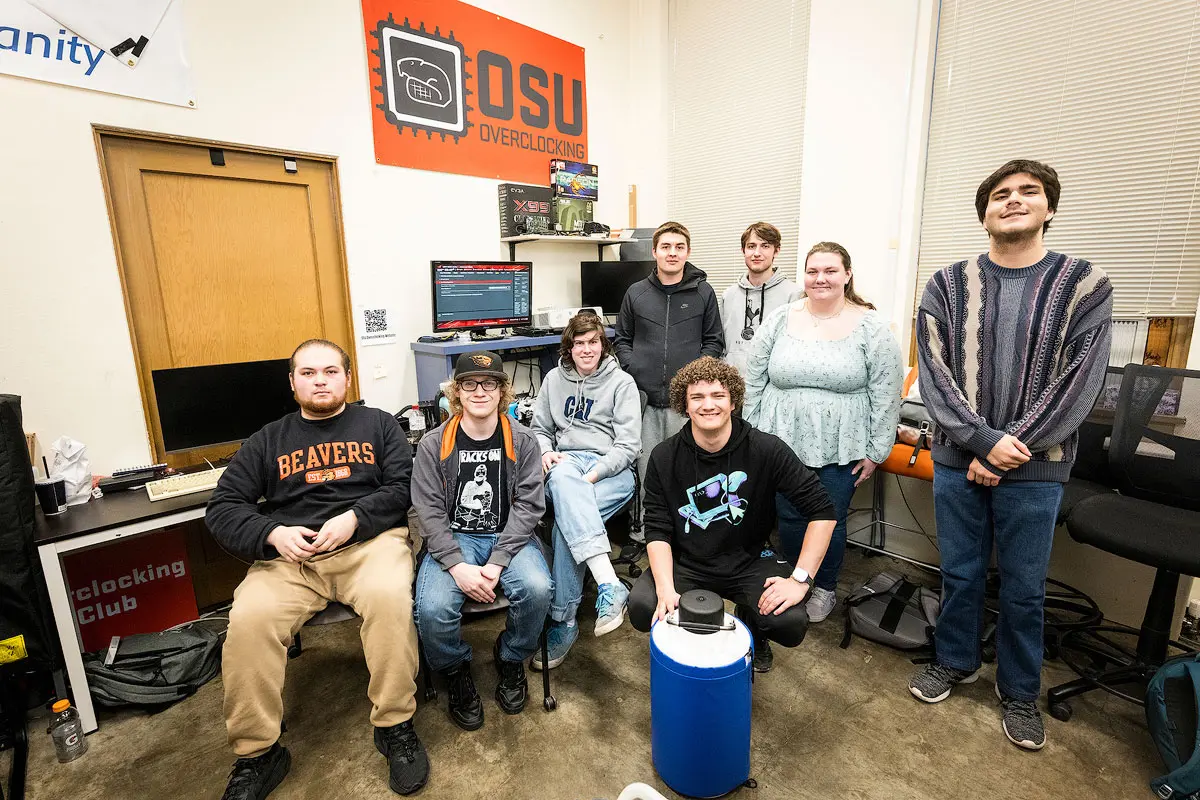
A thin layer of frost creeps across a liquid-nitrogen cooling pot as students lean over an open computer rig in Dearborn Hall, their eyes shifting between the hardware and a nearby monitor where temperature readings, voltage values, and benchmark scores stream in real time. The numbers fluctuate rapidly as steady hands make adjustments, each change pushing a processor at the heart of the rig a little further. For members of Oregon State University’s Overclocking Club, it is a familiar rhythm — the blend of precision, experimentation, and teamwork that defines their weekly workbench sessions.
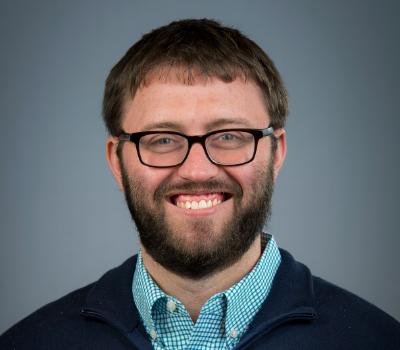
“Our whole mission is asking a computer chip to do more than it wants to do — and then figuring out how to keep it alive while we do it,” said Josh Gess, the club’s faculty adviser and an associate professor of mechanical engineering. He laughed as he added, “You are basically putting a Lamborghini engine into a Pinto and saying, ‘Good luck.’ But if you can cool a Lambo, you can cool a Pinto.”
The Overclocking Club, founded eight years ago by Gess and former graduate student Matt Harrison, has grown from a niche interest to a world-class team. Oregon State is the only university with a dedicated overclocking program, and members now rank among the top competitors on HWBot, the global benchmarking platform.
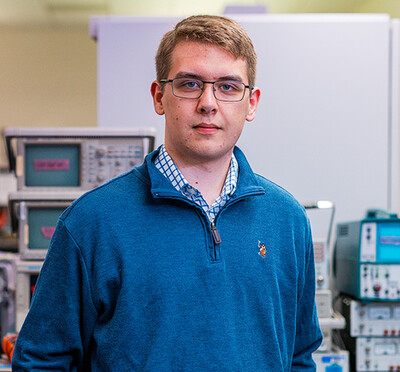
“We are currently in the top 0.5 percent worldwide, and we are doing that while taking classes and working jobs,” said Zander Ray, a senior in mechanical engineering.
Building an intercollegiate league
The team’s rise has earned attention, support, and investment from industry. A chance meeting with Intel engineers gave Gess the opportunity to describe the club, leading to a campus visit, and long-term partnership.
“They saw what we were doing and said, ‘Nobody else is doing anything like this.’ Their support has made all of this possible,” Gess said.
Now, with backing from Intel, Oregon State is leading the creation of the first intercollegiate overclocking league, designed to give universities a structured way to participate in extreme performance engineering.
Dan Ragland, a senior principal engineer at Intel, is one of the team’s primary sponsors. He said the idea of supporting the team, and now a whole league, emerged from a clear need in the industry.
“We always need fresh ideas to advance performance optimization to the next level,” Ragland said. “Building a league is a great way to draw in brilliant minds to advance the PC and data center industry.”
Gess says that there are sponsored professional overclockers who get the newest chips to set world records “But there is no reason students should not be learning these same skills. These students are pushing chips under cryogenic conditions. When they go into the semiconductor workforce, they are ready on day one.”
At least a dozen other colleges are involved directly or expressed interest in joining the new league, and Gess said he feels confident they will have competitions, including a national championship, in place by the summer of 2027.
This year, Gess will work to recruit more members, and there will be a series of online competitions held. “This will be a way to work out the bugs and nail down the rules and setup for a ‘March Madness’-style tournament next year,” he said.
How competition works
In the developing league, teams will work with chips that have been “binned,” or sorted by a professional overclocker to ensure fairness.
“You do not want one university getting a magic golden chip,” Gess said. “So, an expert tests a batch, finds comparable ones, tosses them in a bag, shakes it up, and ships them off.”
Ray noted that working with even a high-quality chip requires tremendous skill. “People think the silicon lottery means you just win with the right chip, but you still need a ton of expertise,” she said. “Most people would kill the chip before ever reaching that level.”
During competition, teams benchmark their systems on HWBot, adjusting voltage, temperature, and software settings to extract every bit of performance. Sometimes that means employing unconventional tricks.
“There are things like unplugging a monitor cable mid-test to gain efficiency,” Ray said. “Stuff you would never think of. It is basically NASCAR — everything is equalized, and what you are really measuring is the driver. In our case, the driver is the engineer.”
More than performance
For many students, the club has been a life-changing experience.
Ray nearly never joined at all. “I am pretty introverted. I showed up to a club meeting early one day, saw the light on, and almost walked away,” she said. “Not leaving changed everything.” She has since built deep industry connections, earned internships, and become one of the world’s top overclockers. “I never expected to be one of the best. A year and a half ago, I would have been scared to open a computer.”
associate professor of mechanical engineering
Blue Primary, Yellow Secondary
Ashley Bailey, the club’s president and a mechanical engineering senior, had a similar experience.
“I had never touched a desktop PC before joining,” she said. “And now I have a lab job, my honors thesis, and opportunities I never imagined. I just fell in love with it.”
She now works as an undergraduate research assistant in the Enhanced Heat Transfer Lab, where she has contributed to multiple projects, including one supported by the National Science Foundation FUSE project. A Hewlett‑Packard collaboration forms the basis of her honors thesis, which investigates pressure‑drop behavior in advanced cooling systems for high‑performance computing.
Bailey also leads the club’s K-12 outreach program, which introduces younger students to computing using damaged or “dead” hardware.
“We did not have a STEM program where I grew up,” she said. “So, seeing kids light up when they get hands-on with real hardware — that is the best part. They build an entire PC without electricity and learn the basics of overclocking in a way they can understand.”
As the intercollegiate league grows, Ragland said success could take many forms. But for him, there is a deeper goal than wins and losses. “I want the league to inspire students to be interested in technology through overclocking,” he said. “I want them to share the joy and the drive to learn. If future leading minds in PC, AI, or data‑center technology emerge from the league, that would be mission accomplished.”
Why Oregon State?
The question of why this program thrives at Oregon State comes up often. Gess has a clear answer.
“This is the Silicon Forest. We are surrounded by industry,” he said. “But more than that, the OSU student has grit. They are willing to bang their head against a wall until they figure it out.”
“I’ve seen firsthand their growth and demonstrated abilities,” said Ragland. “Their well‑balanced application of engineering fundamentals — from thermals to electricals to software — gives OSU an excellent edge.”
Looking ahead, Gess sees collegiate overclocking’s popularity growing. “Everyone who has a robot, rocket, or racecar team will want to have one of these teams, too.”
As the new league takes shape, he is confident Oregon State will continue to lead.
“We are going to beat other top engineering schools — anyone who shows up,” he said. “We will help build the league. But we are also here to compete.”