
Introduction
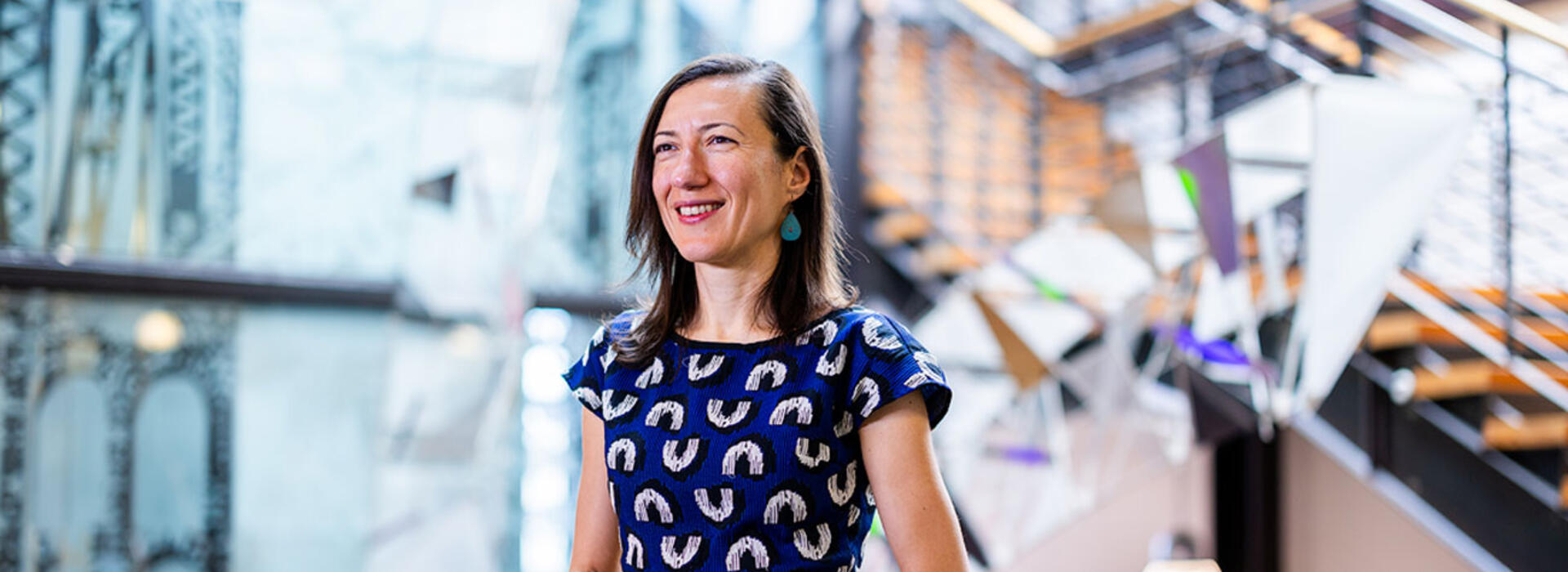
A drone glides under an aging bridge and moments later the physical structure is transformed into data. For Yelda Turkan, associate professor of geomatics, this isn’t magic — it’s the future of infrastructure maintenance.
“You’re basically creating a digital version of your physical asset,” Turkan said. “It contains the geometry, the condition — all the information you need to make better decisions to extend the life of a structure.”
A digital twin blends lidar scans and sensor data into one living model. Instead of comparing documents — drawings, inspection notes, photos — engineers consult a single, updated model. “In the past, everything was fragmented,” Turkan said. “The digital twin brings it all together in one place.”
With lidar-equipped drones, a team can capture the real time status of a structure at high resolution and with a precision. “It’s faster and safer,” Turkan said. “Instead of a person strapped to the side of a bridge, you operate a drone remotely.”
Building occupants benefit, too. Turkan points to climate comfort in office spaces; rooms that run too cold in summer or too warm in winter. With a digital twin, sensors can feed real‑time data into a model that facilities managers can easily interpret.
“Digital twins can help decrease energy waste,” Turkan said.
Getting AI involved
But creating these detailed models isn’t simple. Current workflows require heavy manual input. Turkan is tackling that through multimodal AI — software that can learn from 3D geometry, point clouds, and design drawings simultaneously.
“The biggest bottleneck for AI in infrastructure is data,” Turkan said. “We simply don’t have enough labeled datasets.”
To fix that, her team is building open‑source synthetic datasets. One forthcoming paper, submitted to the 2026 ASCE International Conference on Computing in Civil Engineering, presents an automated way to generate parametric bridge models, simulated scans, and natural‑language descriptions to train advanced AI. This global effort includes faculty members André Borrmann and Florian Noichl of the Technical University of Munich, and doctoral student Salman Ahmed.
“This work is a collaborative effort, and the partnership has been incredibly rewarding,” Turkan said.
Huang Complex
Oregon State itself is becoming a test bed — notably the Jen‑Hsun Huang and Lori Mills Huang Collaborative Innovation Complex. In collaboration with industry partners such as CutMyTimber, a mass timber fabricator, and Autodesk, an engineering software developer, OSU researchers are exploring how digital twins and automation can support industrialized construction — building more like manufacturing, with off-site production and reduced waste — especially for mass‑timber systems.
“CutMyTimber has very detailed 3D models of the Huang Complex at the fabrication level,” Turkan said, “and they’re willing to share that data.” The 143,000 square-foot complex, which features mass plywood panels for columns and beams, is planned to open in 2027 and was made possible with generous gifts to the OSU Foundation from alumni couple Jen-Hsun Huang and Lori Mills Huang and the Wayne and Gladys Valley Foundation.
Campus buildings offer real‑world complexity for testing. “Other universities have already begun making campus‑wide twins to manage energy and space use, and OSU could follow suit,” Turkan said. “They could support facilities management, energy efficiency, planning — many different needs.”
associate professor of geomatics
Blue Primary, Yellow Secondary
Circular construction
In another effort to address climate change, Turkan leads research in circular construction where RFID tags record the history of each building component, helping determine whether and how materials can be reused in the future. “The tags can store everything you’d need to decide whether a component can be reused,” she said.
Turkan’s enthusiasm for this work resonates with students. Many are eager to work with robots, sensors, and AI, which are fields that have historically lagged in construction and infrastructure industries. Turkan believes the excitement will translate into a stronger future workforce. “Students are really excited about these digital technologies,” she said. “You have to be computer‑savvy now. And you need to work with computer scientists.”
The research can have an unexpected look to it, too. Turkan recently acquired a Unitree Go2 EDU Plus, a dog‑sized walking robot fitted with a Hesai XT16 LiDAR that collects laser scans in unsafe or hard‑to‑reach places. After earthquakes or on hazardous sites, for example, the sensor-laden dog could go in first to gather essential data. The purchase was supported by a Kiewit Strategic Research Investment Fund grant, and Turkan plans to take it out for field demonstration tests soon.
Turkan’s work merges advanced computing with real‑life needs, providing students with hands‑on experience, and helps communities make data‑driven, climate‑smart decisions. In her view, the purpose of the work is simple: “Digital twins make our world more transparent, more proactive, and more resilient.” And as Oregon’s infrastructure ages, that clarity has never mattered more.