
Introduction
Before Jackson Harter began modeling the startup sequences of space nuclear reactors for NASA, he was perfecting his knife skills. A self-described late bloomer in science, Harter spent nearly a decade working as a culinary instructor and a cook in restaurants from San Francisco to Portland before finding his way into the nuclear engineering program at Oregon State University.
“I didn’t do very well in high school,” Harter said. “But I was a prolific reader. I started following science news in my early twenties. When I learned about the Large Hadron Collider coming online, I spent about a year looking into how I could contribute to science or engineering.”
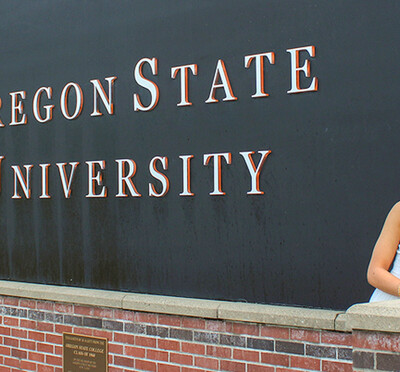
That curiosity eventually brought him home — to Oregon State University, where the campus’s TRIGA reactor had long been a local landmark. “I grew up in Corvallis, so I knew about the reactor,” he said. “That familiarity is what led me to nuclear engineering.”
When Harter started at Oregon State, the transition from the kitchen to the classroom wasn’t easy. But with determination and support from mentors, he found his footing. In his junior year, he joined the research group of Andrew Klein, now emeritus professor of nuclear engineering, and began exploring reactor physics. Harter eventually met Todd Palmer, Distinguished Professor of Nuclear Engineering, who would become his master’s and Ph.D. advisor. “Todd taught me the scientific method — what to look for, the questions to ask,” Harter said. “He’s a phenomenal guy, and I’m proud to call him my friend now.”
Award-winning multiphysics engine
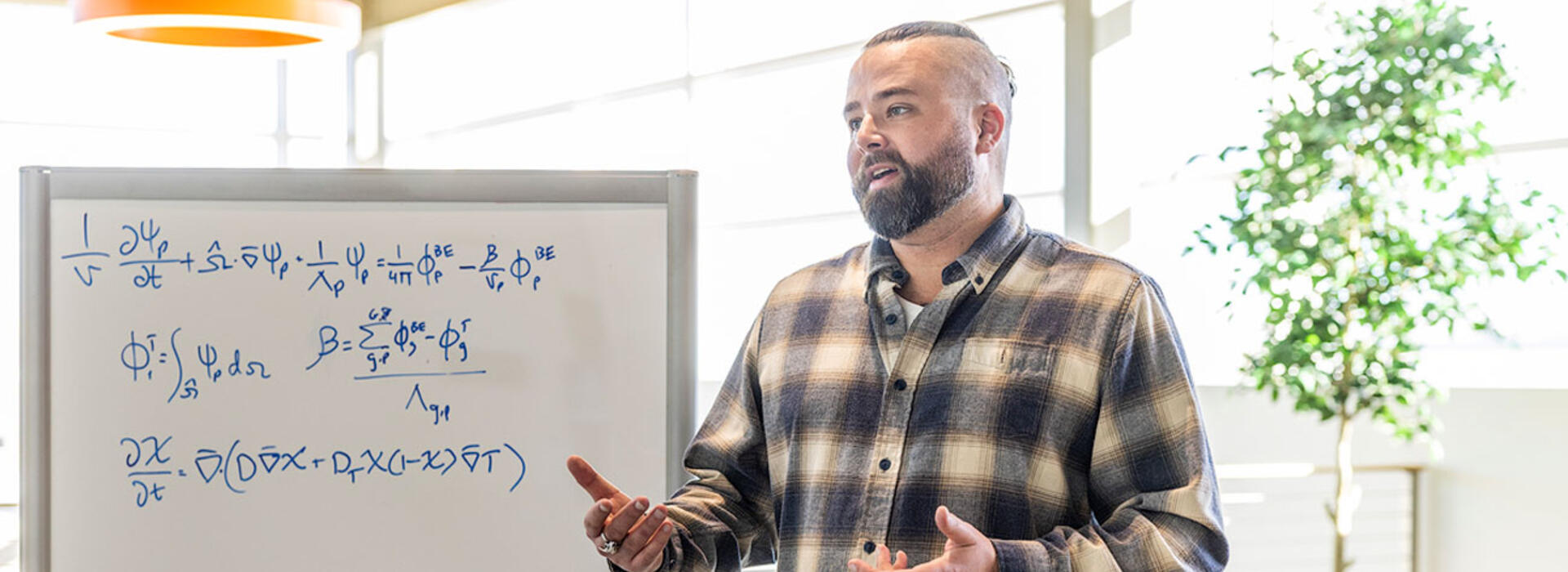
Harter’s graduate research focused on modeling phonon transport — the microscopic vibrations that carry heat through materials.
“My work was primarily in microscale or atomic-scale particle transport,” he said. “We wanted to predict how materials in a nuclear reactor, such as the nuclear fuel, change as they’re irradiated and heated.”
His computational methods would become a key part of Griffin, Idaho National Laboratory’s advanced multiphysics simulation code for reactor modeling that was recently recognized with an R&D100 Award.
B.S. nuclear engineering ’13, M.S. ’15, Ph.D. ’19
Blue Primary, Yellow Secondary
“Griffin can simulate neutron, phonon, photon, and electron transport,” Harter said. “It’s a one-of-a-kind tool that supports everything from microreactors to space reactors.”
Advancing space nuclear power
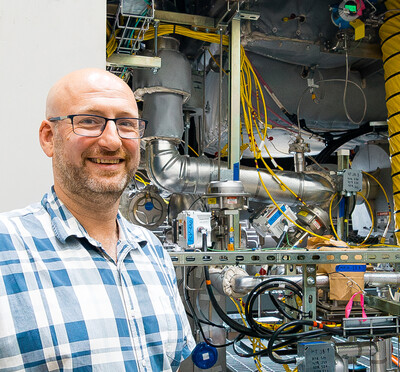
After completing his Ph.D. in 2019, Harter joined INL full-time, where he now works as a nuclear engineer and researcher on projects that blend advanced computing and nuclear physics. His current focus: space nuclear power, a field with roots in the ambitious reactor programs of the 1950s and 1960s, but which is now facing new technical and operational challenges.
“A large focus right now in the space nuclear field is developing tools for reactor startup and shutdown that can operate autonomously, without human intervention,” he said. “In space, signal delays between Earth and distant spacecraft make real-time human control nearly impossible, so reactors must be able to operate safely on their own.”
In 2025, Harter co-authored a paper on uncertainty quantification and sensitivity analysis for the startup of a nuclear thermal propulsion reactor — a nuclear rocket — using the MOOSE Stochastic Tools Module framework developed at INL. “It’s the first application of MOOSE’s stochastic tools to such a large and complex problem,” he said.
Harter’s team’s simulations are helping NASA and the Department of Energy identify the most efficient and safest path for reactor startup, by accounting for massive temperature gradients and material stresses that occur when a reactor goes from zero to full power in seconds. The methods they have developed are now being applied to other nuclear reactor applications, broadening their impact.
Making connections across national labs
Beyond his technical work, Harter mentors interns and leads efforts to expand space nuclear research collaborations across the national lab system.
“My goal is to have a consistent team of interns working on projects that align with national missions for DOE, NASA, and Space Force,” he said. “It’s important that students learn how to work in teams and take responsibility for real-world challenges.”
Looking ahead, Harter is developing a multi-physics, multi-scale computational framework that links atomic-level models to engineering-scale predictions — a tool that could transform how materials are designed for extreme environments, including nuclear reactors.
“The nuclear industry has relied on empirical fits and approximations for decades,” he said. “We can do better. I want to help make that happen.”
Staying connected to Oregon State
Through it all, Harter remains deeply connected to Oregon State. Over the past few years, he’s visited campus multiple times to give talks and meet with faculty.
“My experience at Oregon State was phenomenal,” he said. “I had professors who challenged me and friends who supported me.”
He credits OSU with providing both the foundation and the confidence to pursue complex problems at the frontier of nuclear science. “I still deal with imposter syndrome sometimes,” he said. “But Oregon State helped me believe that I could do this.”