

Human-Robot Interaction/Teaming
Robotics Faculty Research Area
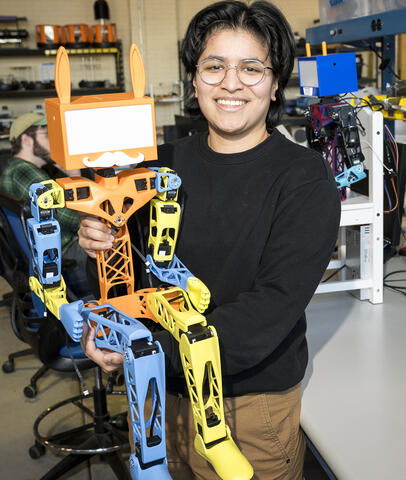
Human-robot interaction involves human socialization or goal-directed task performance with computational and/or mechanical robots. In general, human-robot interaction encompasses both coordinated and uncoordinated human-machine system activity. The scope of this activity depends on the level of robot automation or autonomy as a basis for structuring physical or cognitive interactions. Common design challenges, such as the modalities of information presentation, timing, location, etc., are also considered. Human-robot teaming involves coordinating roles, responsibilities, handoffs, and other aspects to support collaborative, dynamic interactions between humans and one or more robots in pursuit of a common goal.
Human-robot interaction research aims to determine how robots can effectively and safely support humans in interactive activities, informed by system design properties. This research may also define task demands and human information-processing needs that are translated into system design and prototypes. Human-robot interface design research involves modeling the cycle of human-robot goal formulation, articulation, action planning, and execution, and feedback to provide a basis for usable artifact design and effective human-robot communication. Human-robot teaming involves measuring such communication and interaction in terms of the degree of collaboration, the quality of communication, the degree of trust, the capability for team adaptation, etc.
The areas of human-robot interaction and teaming are vast. They include: agricultural operations (e.g., assisting manual harvesting activities), assistive technologies and healthcare (e.g., rehabilitation robots), defense operations (e.g., swarm use for surveillance), large-scale systems maintenance operations (e.g., teleoperator use for offshore rig welding), material handling and manufacturing systems (e.g., collaborative robots for high-paced assembly), and disaster and first response. Such applied research is grounded in established empirical methods, including: ethnographic studies and focus groups; task and work analysis; design of human factors experiments for lab and field testing; data/signal coding/processing for statistical analysis; and scientific inferencing on design features and enhancements to optimize system performance and safety.
Faculty

Julie A. Adams
Professor | College of Engineering Dean's Professor
Additional Positions
CoRIS Associate Director for Research
Research Groups
Artificial Intelligence and Robotics | Software Engineering and Human-Computer Interaction


David Kaber
College of Engineering Dean's Professor
Additional Positions
Associate Head of Research Programs
Research Groups
Industrial and Systems Engineering

Stefan Lee
Associate Professor | Brent and Elaine Leback Professor in Engineering
Research Groups
Data Science and Engineering | Artificial Intelligence and Robotics

Bill Smart
Professor
Additional Positions
CoRIS Associate Director for Academics
Research Groups
Artificial Intelligence and Robotics | Robotics

Cristina G. Wilson
She/Her
Assistant Professor-Senior Researcher
Research Groups
Robotics