


Not Accepting New Students
Ross Hatton
317 Graf Hall Corvallis
Corvallis, OR 97331
United States
About
Biography
Ross L. Hatton is an associate professor of Robotics and Mechanical Engineering at Oregon State University, where he directs the Laboratory for Robotics and Applied Mechanics (LRAM). He received his Ph.D. and M.S. degrees from Carnegie Mellon University and an SB from the Massachusetts Institute of Technology.
His research focuses on understanding the fundamental mechanics of locomotion and sensory perception, making advances in mathematical theory accessible to an engineering audience, and on finding abstractions that facilitate human control of unconventional locomotors. Hatton’s research group also works with local industry to transfer modern developments in robotics from the lab to the factory or into commercial production. Dr. Hatton is a 2017 recipient of an NSF CAREER Award.
Degrees
Awards/Accolades
Documents
Research
Research Interests
Dr. Hatton's research interests lie at the intersection of robotics, mechanics, and biology. His work includes motion models for snakes and snake robots and development of fundamental mathematical tools for the study of locomotion.
Research Groups
Research Website
Labs
Publications
Hatton, R. L., & Choset, H. (2015). Nonconservativity and noncommutativity in locomotion. European Physical Journal Special Topics: Dynamics of Animal Systems, 224, 3141–3174.
Hatton, R. L., & Choset, H. (2013). Geometric swimming at low and high Reynolds numbers. IEEE Transactions on Robotics, 29, 615–624.
Abate, A., Hurst, J. W., & Hatton, R. L. (2016). Mechanical antagonism in legged robots. Proceedings of the Robotics: Science and Systems Conference, 1–8.
Porter, M. M., Adriaens, D., Hatton, R. L., Meyers, M. A., & McKittrick, J. (2015). Why the seahorse tail is square. Science, 349(6243), 6683.
Marvi, H., Gong, C., Gravish, N., Astley, H., Travers, M., Hatton, R. L., Mendelson, J. R., III, Choset, H., Hu, D. L., & Goldman, D. I. (2014). Sidewinding with minimal slip: Snake and robot ascent of sandy slopes. Science, 346(6206), 224–229.
Recent Related Stories
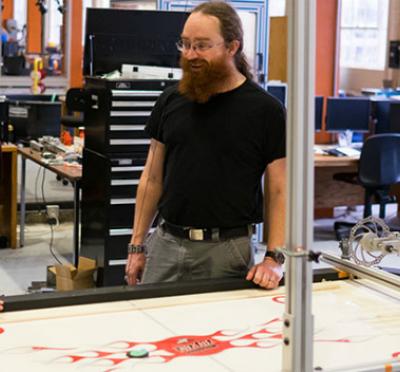
Faculty Spotlight: Ross Hatton
The varied research interests of Ross Hatton, assistant professor of mechanical engineering, converge at the intersection of robotics, mechanics, and…

More early-career standouts for MIME
Three MIME faculty have achieved early-career benchmarks by earning prestigious and competitive research awards from the National Science…