
Introduction
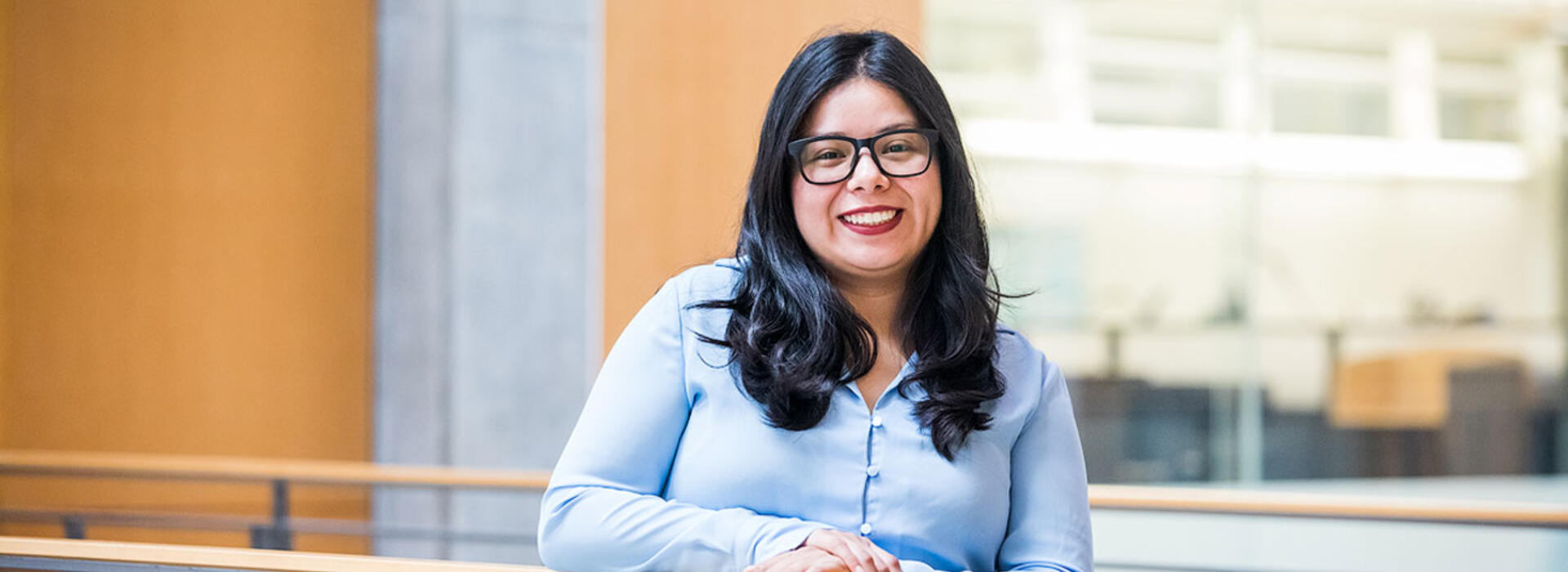
When Karina Puente talks about her research, she often starts with a deceptively simple question: Can a robot feel the moment an object begins to slip — and respond before it drops it?
As a third-year Ph.D. student in the Intelligent Machines and Materials Lab at Oregon State University, Puente works under the guidance of Associate Professor Joe Davidson to improve how robots sense and react to contact. Her research explores slip detection and grasp failure in robotic hands — developing tactile sensing and machine learning systems that can interpret subtle pressure changes during manipulation.
Puente’s goal is to make robotic hands more adaptable across environments — whether underwater, in agricultural settings, or in unstructured field conditions.
“My research has shifted from designing underwater grippers to developing sensing techniques that work across many applications,” she said. “If a robot can understand touch, it can handle uncertainty much better.”
Getting – and keeping – a grip
Her work builds on tactile sensing technologies pioneered by fellow Ph.D. student Aiden Shaevitz, who designed the custom underwater tactile sensors used in Puente’s experiments. Using these flexible barometric sensors, Puente collects data on how grasp stability changes over time, then trains algorithms to detect the onset of slip — often with greater accuracy than a human operator relying on vision alone.
“Vision systems are limited when environments are murky or unpredictable,” Puente said. “Tactile sensing gives robots a sense of awareness they’ve never had before.”
By advancing this kind of touch-based intelligence, Puente hopes to enable future robotic systems to interact more safely and effectively with the world — from deep-sea exploration to delicate crop harvesting.
robotics Ph.D. student
Blue Primary, Yellow Secondary
From summer research to graduate student
Puente first connected with Oregon State University through a summer research experience for undergraduates, where she worked with robotics faculty member Naomi Fitter and her graduate students on haptic systems — technologies that allow robots to sense and respond to touch. “That experience opened the gates,” she said. “I knew I wanted to do more of this kind of research, but at the Ph.D. level.”
Puente’s decision to pursue her doctoral studies at Oregon State was deeply connected to the university’s cutting-edge robotics program. But her decision was about more than research. Coming from Texas, Puente wanted an environment where she could grow both professionally and personally.
“I was immediately drawn in by the community here at OSU,” she said. “It was scary being so far from home, but I slowly found my place and built a small Hispanic community for myself, which was really important.”
Finding a community at Oregon State and ASML
That sense of belonging has helped her thrive in a field where representation still lags. As one of the few Hispanic women in her department, Puente has become an advocate for diversity in engineering. In addition to a Promising Scholar Fellowship, she was awarded a GEM Fellowship, a nationally competitive program that supports underrepresented students in STEM through graduate funding and industry partnerships.
In 2025, her GEM Fellowship led her to a controls and automation internship with ASML, a global leader in semiconductor manufacturing technology. Based at the company’s San Diego office, Puente worked on plasma control systems — projects far removed from underwater robotics but rich in transferable skills. She developed diagnostic tools using Grafana dashboards, automated data parsing scripts, and helped define key performance indicators for system accuracy. The experience strengthened her programming and systems integration expertise while showing her how engineering research translates into industry practice.

“It was exciting to contribute across different sites and be part of a community that supports learning and professional growth,” she wrote about the experience. Her internship was extended through November, allowing her to continue building on the projects she started.
Learning to tell a story about research
At Oregon State, Puente’s work also extends beyond the lab. She participated in the Graduate Research Showcase, a campuswide event that helps students communicate their work to broad audiences. For Puente, who describes herself as introverted, the experience was transformative.
“Our coach taught us how to really engage the audience,” she said of her showcase presentation. “We practiced explaining our research without jargon. It felt like giving a TED Talk. I learned how to tell a story, not just report data.”
Her growing confidence as both a communicator and researcher reflects her larger ambitions. She hopes her work will inspire young engineers — especially women and students from underrepresented backgrounds — to pursue robotics. “I want people to see that engineering really needs everyone,” she said.