
Introduction
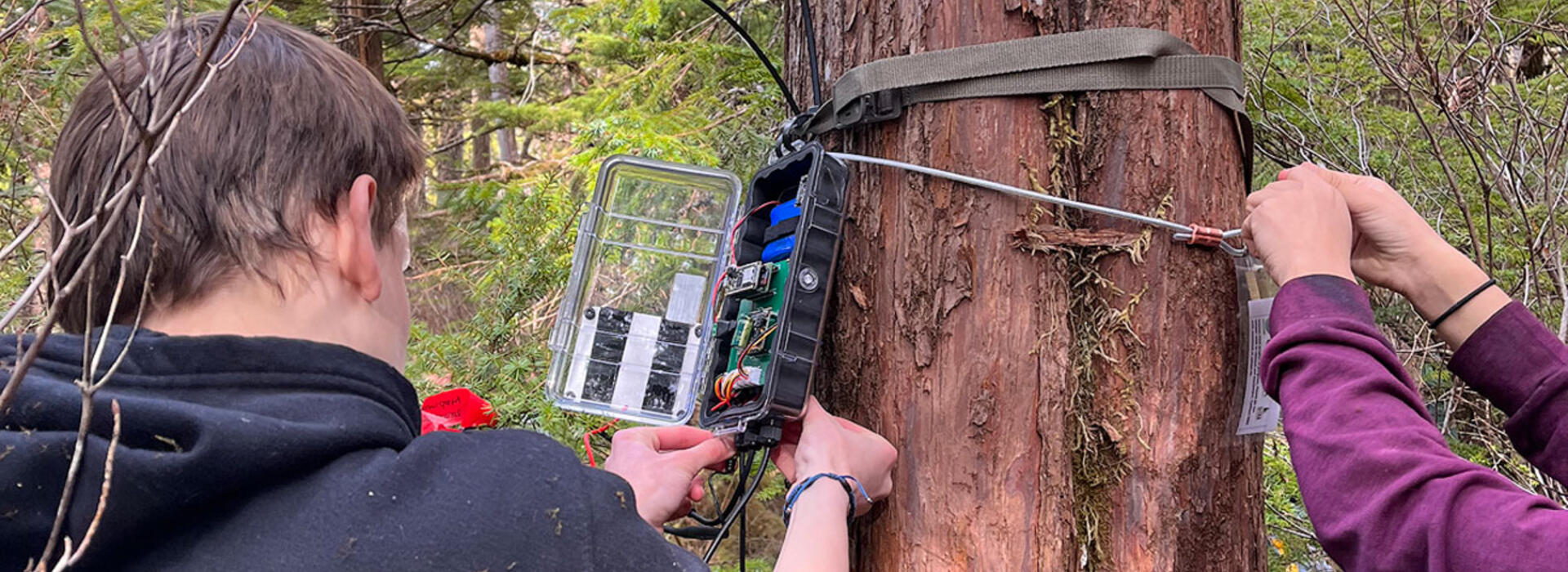
On a summer day in Southeast Alaska, a group of students crouches near a stream, lowering a grapefruit-sized device into cold, fast-moving water. The sensor looks simple, almost improvised, but it is quietly collecting temperature, pressure, and turbidity data that could one day help communities better understand landslides and flooding. The device was designed and built by undergraduates at Oregon State University.
Back in Corvallis, in a newly constructed lab filled with 3D printers, soldering irons, and half-assembled enclosures, those same students are already thinking about what to improve next.
This is the OPEnS Lab — the Openly Published Environmental Sensing Lab — where engineering education, open‑source design, and real‑world impact intersect.
Founded on the idea that environmental instruments should leverage technological innovations while being affordable, adaptable, and accessible, the OPEnS Lab has become a place where students don’t just learn engineering concepts — they build transformative tools that are deployed in forests, vineyards, rivers, and farms around the world.
OPEnS Lab, which is primarily supported and administered by the College of Agricultural Sciences, began with a realization. About eight years ago, John Selker, a distinguished professor of biological and ecological engineering, challenged his nephew, fresh off building a 3D printer, to design a scientific instrument rather than a novelty. Together they built a unique river-monitoring device that could be printed cheaply, modified parametrically, and shared digitally.
“That cracked my world open,” Selker said. “A part that once would have cost thousands of dollars could suddenly be redesigned in minutes and printed for pennies.”
Selker quickly saw the implications. Advances in 3D printing, microcontrollers, sensors, and ultralow-cost telemetry had arrived simultaneously, but environmental sensing had barely changed. Instruments were still expensive, proprietary, and slow to evolve. At the same time, engineering students were hungry for hands-on work that mattered.
OPEnS Lab was born at that intersection.
associate professor
Blue Primary, Yellow Secondary
Engineering that doesn’t fit in a syllabus
Today, roughly 35 undergraduates work in OPEnS Lab at any given time, supported by faculty and professional staff. Students from mechanical, electrical and computer, and ecological engineering share benches and responsibilities. Projects last years, not weeks. Documentation matters. Field failure is expected.
“In a traditional class, problems are wrapped up neatly,” said Chet Udell, an associate professor in the Department of Biological and Ecological Engineering. “Here, students have to figure out what the problem actually is — and then live with the consequences of their design choices.”
For students, that openness can be both challenging and freeing.
Zahra Vania, a mechanical engineering major who has worked in OPEnS Lab for two years, describes it as a place where growth happens without artificial constraints.
“It’s nice to have a space to grow as an engineer without the pressure you get in internships,” Vania said.
That freedom comes with responsibility. OPEnS projects are largely student-led, structured around real-world constraints, and rarely tidy — much like engineering work outside a university setting.
For Evan Hockert, a double major in electrical and computer engineering and mathematics, that meant spending more than two years developing the Evaporometer, a device designed to measure evaporation and rainfall while surviving months in the field without maintenance.
“I got more hands-on experience at OPEnS Lab than in all of my classes combined,” Hockert said. “It’s where I actually learned the most about how to be an engineer.”
That education is deliberately uncomfortable. Devices leak. Sensors break. Code that worked yesterday fails in the rain.
“Mother Nature is a brutal reviewer,” Udell said. “She finds every flaw.”
Measuring what matters
One of OPEnS Lab’s most widely adopted technologies is its next-generation dendrometer, a sensor that measures microscopic changes in plant growth to assess water stress. Traditional dendrometers rely on mechanical plungers that introduce friction and temperature error. OPEnS redesigned the instrument using carbon fiber, chosen not for aesthetics, but because it barely expands with heat, and a noncontact magnetic sensing system.
The result is a device capable of detecting changes as small as half a micron outdoors.
The dendrometers are now used on grapevines, blueberry bushes, and hazelnut trees across Oregon and beyond. At Biosphere 2 in Arizona, researchers are using them to study cacao trees inside one of the world’s most controlled rainforest environments, gaining new insight into how climate stress affects plant physiology.
Another project called WeatherChimes, inspired by wind chimes, translates environmental data — temperature, humidity, and light — into music. The project is being used with students in Southeast Alaska, helping them experience environmental change through sound rather than spreadsheets.
Smart Rock is a low-cost, open-source water-quality sensor designed to be used by non-engineers. These sensors have been deployed in partnership with Native Alaskan organizations as both educational tools and field instruments.
When wildfire smoke threatened Oregon vineyards, the wine industry needed an affordable way to monitor air quality quickly. OPEnS Lab partnered with Oregon State’s Food Science and Technology program to develop WISP, an air-quality sensing platform focused on smoke exposure and smoke taint, the ashy flavor that can ruin a wine during fermentation.

A new home for OPEnS Lab
Every OPEnS project follows the same principle: Designs are openly published for researchers, while industry partners license the technology for commercial use — a hybrid model that accelerates innovation without sacrificing rigor.
That approach is now reflected in OPEnS Lab’s new, purpose‑built space in Hovland Hall. The expanded facility brings together five connected lab rooms, giving students improved access to fabrication tools, electronics benches, and shared work areas designed for rapid iteration. The layout supports multiple teams working in parallel and reflects how OPEnS projects actually function: across disciplines, across semesters, and from prototype to field deployment.
To learn more about OPEnS Lab and its projects, visit Open Sensing.