

Introduction
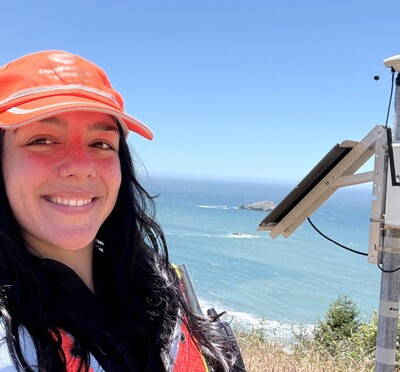
Artificial intelligence Ph.D. student Fiona Victoria Stanley Jothiraj’s first brush with impactful technology came in high school, when she developed a mobile app to help Indian students predict university admissions based on their exam scores. The app, which drew attention from national media and even a U.S. university professor, was a practical solution to a problem faced by thousands of students each year.
“People were happy to have it because there hadn’t been anything like that up until that point,” she said.
The experience sparked her interest in building things, and during her undergraduate years, Stanley Jothiraj built robots — 3D-printed arms, path-following machines, and humanoid bots — while gravitating toward programming and hardware design rather than electronics. She was introduced to machine learning at the same time, which deepened her interest in the field. After graduation, she worked as a machine learning engineer for a software company in India. A personal milestone and subsequent move to Washington State prompted her to explore graduate programs in the U.S.
Creating something new
She landed at the University of Washington, where her research focused on federated learning for diffusion models, a cutting-edge approach to decentralized machine learning.
“When all your data is in one central entity, it’s prone to more privacy issues,” she said. Her work proposed training generative AI models in a decentralized environment, addressing privacy concerns in applications ranging from healthcare to financial institutions. The project led to a published paper and invitations to speak at conferences, and its influence can be seen in privacy-preserving AI the frameworks now adopted by industry leaders.
“People were getting in touch with me to understand how to replicate something like this,” she said. “It helped me understand that I liked creating something new that hadn’t existed before.”
AI for social good
Stanley Jothiraj’s decision to pursue a Ph.D. was driven by her desire to create new knowledge and to apply AI for social good.
artificial intelligence Ph.D. student
Blue Primary, Yellow Secondary
Oregon State University stood out for its interdisciplinary approach and its unique AI Ph.D. program. “It was the first time I’d seen an AI program for a Ph.D., which I don’t think a lot of universities offered at the time,” she said.
Just as important was OSU’s interdisciplinary strength. “I love the idea of not just sitting in your little cocoon,” she said. “A lot of the faculty and researchers are involved in interdisciplinary research, and OSU offers some of the top programs in agriculture, natural, and environmental sciences. It was a perfect fit for me.”
Transferring knowledge across domains
Stanley Jothiraj found the ideal mentor in Rebecca Hutchinson, whose research spans quantitative ecology and machine learning, which was a major draw. Her research with Hutchinson began with species distribution modeling, predicting the habitats of over 200 bird species in Oregon. The work challenged conventional methods by sampling environmental data based on the birds’ locations rather than the observers’, leading to improved predictive performance.
Currently, Stanley Jothiraj is delving into plant-pollinator interactions using a decade’s worth of field observations of bees and flowers from the H.J. Andrews Experimental Forest. Her models aim to uncover the dynamics of bee populations, the impact of weather and invasive species, and the factors driving ecological change. The next phase involves scaling her models to multi-species interactions and integrating interpretable neural networks, balancing the demands of ecological insight with the power of AI.
Stanley Jothiraj’s breadth of experience is reflected in her publication record, which spans topics from traffic fatalities and park visitation to motion detection and sustainability. She credits her wide-ranging experience with helping her transfer knowledge across domains, including a collaboration with engineers at Micron, a leading semiconductor manufacturer. Over two summer internships, she leveraged her expertise in computer vision to automate defect detection in memory chips, reducing analysis time by 90%.
“People were spending days and weeks inspecting every wafer,” she said. “Now, having a system to automate the process, you could do it in a couple of minutes.”
The work resulted in a published paper, an AAAI workshop presentation, and an invitation to return for future collaborations.
Making technology accessible
Beyond research, Stanley Jothiraj is committed to making technology accessible. Her blog posts — on AWS IoT Core, Azure IoT Hub, and her journey to Ph.D. admission in AI — aim to demystify complex topics for students and practitioners.
“I like the idea of putting things simpler for other people to read and making the language more accessible,” she said.
Looking ahead, Stanley Jothiraj aspires to lead AI teams in industry, focusing on projects that deliver meaningful social impact. She values the collaborative, approachable culture at OSU and encourages prospective students to consider the program’s interdisciplinary strengths.
“I have a really close relationship with my advisor, which is very hard to get,” she said. “The faculty here are so approachable. If anybody has an idea to work at the intersection of AI with agriculture, ecology, or related interdisciplinary fields, they should come to OSU because you have it all here.”