

Introduction
When Madison Lenz arrived at Oregon State University, she knew she wanted to study something that combined technical rigor with human impact. Industrial engineering — where data analysis, systems design, and problem-solving meet people — proved to be the perfect fit.
“Industrial engineering lets me look at the big picture,” she said. “It’s about improving systems that make everyday life work better, whether that involves manufacturing, healthcare, or global development.”
As a second-year student, Lenz has already built a resumé that reflects both her analytical skills and her commitment to service. Between conducting energy audits for Oregon industries, researching how engineers learn, and bringing clean water to rural Cameroon, she’s learned that engineering success is as much about empathy as it is about equations.
Making Oregon industries more efficient
Lenz recently wrapped up a stint as an energy analyst with Oregon State’s Energy Efficiency Center, where teams of students assess facilities across the Pacific Northwest to identify ways to cut waste and save money.
“We’d go into plants, gather data, and find opportunities to improve energy use,” she said. “Then we’d translate that into real, actionable recommendations tied to financial incentives.”
industrial engineering student
Blue Primary, Yellow Secondary
She led assessments, coordinating with plant managers and ensuring that final reports met strict technical and professional standards.
“Being the lead analyst taught me how to balance teamwork and leadership,” she said. “I had to communicate with clients, understand their challenges, and present solutions that make sense for their operations.”
Her work revealed how much even small changes can matter. “You realize that reducing a few kilowatt-hours here or a few gallons of water there adds up to big impacts — for both the environment and the bottom line,” she said.
Researching how engineers learn
Beyond industry projects, Lenz has pursued academic research on STEM education and knowledge mobilization as an undergraduate research assistant. Her team applies Legitimation Code Theory, a framework from cognitive psychology, to explore how engineering students connect classroom learning to professional practice.
“We explored how knowledge is built, shared, and applied,” she said. “That means analyzing transcripts, interpreting patterns, and thinking about how to better prepare future engineers for real-world challenges.”
Her research culminated in a presentation at OSU’s Spring Poster Symposium, where she shared her findings with peers and faculty. “Presenting was nerve-wracking but exciting,” she said.
Global impact through Engineers Without Borders
In December 2025, Lenz led OSU’s Engineers Without Borders USA chapter on its first trip to Matouké, Cameroon, where the team has a newly established partnership with the Rural Development Centre of Cameroon to help the 1,500-member community gain reliable access to clean drinking water.
“Before the trip, I read about sustainable development, but seeing it firsthand changed everything,” she said.
The team conducted community surveys, tested water quality, and collaborated with local leaders to better understand the situation.
“The biggest lesson was that engineering isn’t just about technology — it’s about people and communication,” Lenz said. “You have to listen and adapt as the community’s needs evolve.”
The trip, she added, deepened her appreciation for partnerships and collaboration. “It’s incredible to be part of something that continues to grow and respond to real human needs.”
Hands-on with semiconductors
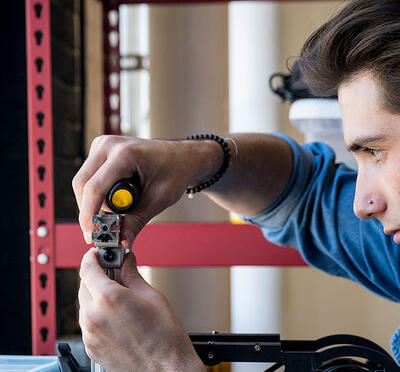
Earlier in her studies, Lenz participated in Analog Devices’ Semiconductor Camp, a two-week summer immersion in microfabrication and robotics. The experience introduced her to cleanroom operations and fabrication techniques such as photolithography, ion implantation, and plasma etching.
“It was my first real exposure to how complex and precise semiconductor manufacturing is,” she said.
Working in small teams, she helped design and build an autonomous guided vehicle that responded to voice commands.
“That project pulled together everything — problem-solving, coding, soldering, and teamwork,” she said. “It made me think seriously about the possibilities in the semiconductor industry.”
Looking ahead
Lenz plans to pursue a career that blends her interests in sustainability, systems optimization, and human-centered design. “I want to keep asking how we can make processes more efficient and equitable at the same time,” she said.
Her time at Oregon State has prepared her to do exactly that.
“Every experience — from research and industry projects to international work has shown me that engineering is about people,” Lenz said. “It’s about finding smarter, more compassionate ways to solve the problems that matter.”